Read the following statement (A) and (R) and choose the correct option.
निम्नलिखित कथनों (A) और (R) को पढ़िए तथा सही विकल्प का चयन कीजिए ।
Assertion (A) : About 2500 years ago, some Janapadas became more important than others and were known as Mahajanapadas. अभिकथन (A) : लगभग 2500 वर्ष पहले, कुछ जनपद दूसरों की तुलना में अधिक महत्वपूर्ण हो गए और इन्हें महाजनपद कहा जाने लगा।
Reason (R) : Proper fortification was done, armies were raised and a proper taxation system was put in place to maintain the armies.
कारण (R) : सही तरीके से किलेबंदी की गई, सेनाएँ खड़ी की गई और सेनाओं के रखरखाव के लिए एक सही कर प्रणाली (व्यवस्था) लागू की गई।
Options / विकल्प :
(A) is false but (R) is true./ (A) गलत है परन्तु (R) सही है ।
(A) is true but (R) is false. / (A) सही है परन्तु (R) गलत है।
Both (A) and (R) are true and (R) is the correct explanation of (A)/(A) और (R) दोनों सही हैं तथा (R), (A) की सही व्याख्या है।
Both (A) and (R) are true and (R) is Not correct explanation of (A) / (A) और (R) दोनों सही हैं तथा (R), (A) की सही व्याख्या नहीं है।
प्राचीन भारत में जनपद धीरे-धीरे शक्तिशाली होकर महाजनपद का स्वरूप ग्रहण कर लिए इन्होने सही तरीके से किले बड़ी की बढ़ी सेनाओं का गठन किया आस-पास के क्षेत्रों को विजित किया और सेनाओं के रखरखाव के लिए एक सही कर प्रणाली लागू गई तथा नवीन प्रशासनिक व्यवस्था की स्थापना की गई। अतः (A) और (R) दोनों सत्य है और (R), (A) की सही व्याख्या करता हैं।
Question 2:
Process of change of rock from one type to another type is known as:
शैल के एक प्रकार से दूसरे प्रकार में परिवर्तित होने की प्रक्रिया को कहते हैं
Rock cycle / शैल-चक्र
Rock decompostion / शैल अपघटन
Rock formation / शैल निर्माण
Rock transformation / शैल परिवर्तन
शैल का एक प्रकार से दूसरे प्रकार में परिवर्तित होने की प्रक्रिया को शैल-चक्र कहते हैं।
Question 3:
Which of the following topics in history could be taught using lived experiences of a community?
एक समुदाय के दिए गए अनुभवों के प्रयोग से इतिहास में निम्नलिखित में से कौन सा विषय पढ़ाया जा सकता है?
Partition of India / भारत का विभाजन
Warfare techniques of Turks / तुर्कों की युद्ध की तकनीक
Revenue system of Shahjahan / शाहजहाँ की राजस्व व्यवस्था
Architectural style of Taj Mahal / ताजमहल की वास्तुशिल्पीय शैली
एक समुदाय के दिए गए अनुभवों के प्रयोग से इतिहास में भारत का विभाजन का विषय पढ़ाया जा सकता है।
Question 4:
'In what ways is a permanent and regular job different from a casual job. Discuss'.
This question attempts to address students ability to _______.
किन-किन तरीकों से स्थायी एवं नियमित नौकरी, अनियमित नौकरी से भिन्न हैं? चर्चा कीजिए ।
यह प्रश्न विद्यार्थियों की ________करने की योग्यता को संबोधित करने का प्रयास कर रहा है?
reason and explain / तर्क करने एवं व्याख्या
compare and contrast / समानता एवं अन्तर
interpret form case studies / केस अध्ययनों से व्याख्या
infer and extrapolate / निष्कर्ष निकालने एवं अनुमान लगाने
यह प्रश्न विद्यार्थियों की 'समानता एवं अन्तर' करने की योग्यता को सम्बोधित करने का प्रयास कर रहा है।
नियमित और अनियमित नौकरी से इस प्रकार भिन्न है- स्थाई नौकरियों में छुट्टियों तथा निःशुल्क चिकित्सा सुविधा मिलती है, परन्तु अनियमित नौकरी में ये सुविधाएँ नहीं मिलती है।
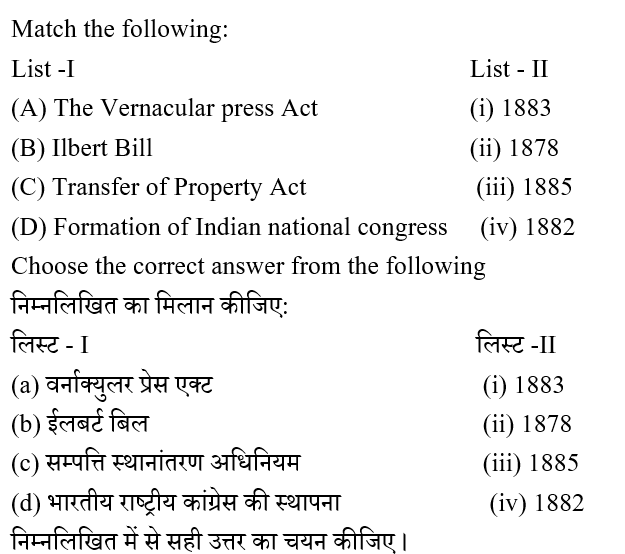
Question 5:
(a) - (iv), (b)-(ii), (c)-(i), (d)-(iii)
(a)-(ii), (b)-(i), (c)-(iv), (d)-(iii)
(a)-(i), (b)-(ii), (c)-(iii), (d)-(iv)
(a) - (iii), (b)-(iv), (c)-(ii), (d)-(i)
सही सुमेलन इस प्रकार है-
लिस्ट I लिस्ट II
वर्नाक्यूलर प्रेस एक्ट 1878
इल्वर्ट बिल 1883
सम्पत्ति स्थानांतरण अधिनियम 1882
भारतीय राष्ट्रीय काग्रेस की स्थापना 1885
Question 6:
The 'Cultural capital' of a student consists of:
एक विद्यार्थी की 'सांस्कृतिक पूँजी' बनी होती है:
availability of digital devices during COVID 19 pandemic. /कोविड 19 महामारी के दौराान डिजिटल उपकरणों की उपलब्धता से
Financial assests in rural as well as urban areas / ग्रामीण एवं शहरी स्थानों में वित्तीय परिसंपत्तियों से
Educational background of the family / परिवार की शैक्षिक पृष्ठभूमि से
historical places that the learner has visited / ऐसे ऐतिहासिक स्थानों से जहाँ अधिगमकर्ता ने भ्रमण किया हो
एक विद्यार्थी की सांस्कृतिक पूँजी परिवार की शैक्षिक पृष्ठभूमि से बनी होती है। प्रत्येक समाज में कुछ लोगों के पास दूसरो की तुलना में मूल्यवान संसाधनों का अधिक हिस्सा होता है- धन संपत्ति शिक्षा स्वास्थ्य और शक्ति । इन सामाजिक संसाधनों को पूंजी के तीन रूपों में विभाजित किया जा सकता है –
(i) भौतिक संपत्ति और आय के रूप में आर्थिक पूंजी
(ii) शैक्षिक योग्यता और स्थिति जैसे सांस्कृतिक पूंजी
(iii) संपर्कों और सामाजिक संगठनों के नेटवर्क के रूप में सामाजिक पूंजी
(iv) विभिन्न वर्गों से संबंधित छात्रों की शैक्षिक उपलब्धियों में विविधता वर्ग की संरचना सांस्कृतिक पूंजी के अन्तर्गत आती है ।
Question 7:
Which of the following regional language was the earliest to be used in official records in the subcontinent?
निम्नलिखित में से कौन सी क्षेत्रीय भाषा का प्रयोग उपमहाद्वीप के सरकारी अभिलेखों में सबसे पहले सबसे पहले हुआ था ?
Malayalam / मलयालम
English / अंग्रेजी
Urdu/ उर्दू
Punjabi/पंजाबी
मलयालय भाषा का प्रयोग उपमहाद्वीप के सरकारी अभिलेखों में सबसे पहले हुआ था । मलयालम भाषा दक्षिण भारत की एक प्रमुख भाषा है जो मुख्यतः केरल और लक्षद्वीप में बोली जाती है। महोदयपुरम का चेर राज्य प्रायद्वीप के दक्षिणी-पश्चिमी भाग में जो आज के केरल राज्य का एक हिस्सा है नौवीं शताब्दी में स्थापित किया गया था। यहाँ के शासकों ने मलयालम भाषा एवं लिपि का प्रयोग अपने अभिलेखों में किया था। भारत की राजभाषा हिन्दी और लिपि देवनागरी है। संघ के शासकीय प्रयोजनों के लिए प्रयोग होने वाले अंकों का रूप भारतीय अंकों का अंतर्राष्ट्रीय रूप ( संविधान का अनुच्छेद 343 (A)।
Question 8:
Which of the following would be the least meaningful learning process for an upper primary student learning about fundamental rights?
मूलभूत अधिकारों के बारे में सीखने वाले उच्च प्राथमिक विद्यार्थी के लिए निम्नलिखित में से कौन सी न्यूनतम अर्थपूर्ण अधिगम प्रक्रिया होगी ?
Use of illustrative examples. / सचित्र उदाहरणों का प्रयोग
Promoting memorisation of all the rights and recalling them through formative assessment./सभी अधिकारों को स्मरण करने एवं उनको रचनात्मक आंकलन के माध्यम से अनुस्मरण करने को प्रोत्साहित करना।
Encouraging different ways of looking at freedom of expression or any other right.
अभिव्यक्ति की स्वतंत्रता अथवा कोई अन्य अधिकार को देखने के भिन्न तरीकों को प्रोत्साहित करना ।
Connecting new knowledge and concerns to pre-existing knowledge. / नवीन ज्ञान एवं सरोकारों को पहले से मौजूद ज्ञान से जोड़ना ।
मूलभूत अधिकारों के बारे में सीखने वाले उच्च प्राथमिक विद्यार्थी के लिए 'सभी अधिकारों को स्मरण करने एवं उनके रचनात्मक आंकलन के माध्यम से अनुसरण करने को प्रोत्साहित करना' न्यूनतम अर्थपूर्ण अधिगम प्रक्रिया होगी। सचित्र उदाहरणों का प्रयोग, अभिव्यक्ति की स्वतंत्रता अथवा कोई अन्य अधिकार को देखने के भिन्न तरीकों को प्रोत्साहित करना और नवीन ज्ञान एवं सरोकारों को पहले से मौजूद ज्ञान से जोड़ना मूलभूत अधिकारों के बारे में सीखने वाले उच्च प्राथमिक विद्यार्थी के लिए अधिकतम अर्थपूर्ण अधिगम प्रक्रिया होगी ।
Question 9:
Films that represent tribals only as people wearing colourful costumes and dancing in groups, may lead to:
फिल्में जो जनजातीय लोगों को केवल रंगीन पोशाकें पहने हुए एवं समूहों में नृत्य करते हुए दिखाती हैं, के क्या परिणाम हो सकते हैं?
attracting the world to the plight of the adivasis./आदिवासियों की दुर्दशा की ओर विश्व का ध्यान आकर्षित करना ।
demonstrating the cultural diversity of tribes. / जनजातियों की सांस्कृतिक विविधता का प्रदर्शन ।
creating stereotypes of tribals. /जनजातियों के प्रति रूढ़िबद्ध धारणा बनाना ।
promoting sale of forest products and tribal craft. / वन-उत्पादों और हस्तकला की बिक्री का प्रोत्साहन ।
फिल्में जो जनजातीय लोगों को केवल रंगीन पोशाकें पहने हुए एवं समूहों में नृत्य करते हुए दिखाती हैं, इसका परिणाम जनजातियों के प्रति रूढ़िबद्ध बनाना हो सकता है। अगर शिक्षक छात्र रूढ़ियों को तोड़ना या चुनौती देना चाहते हैं, तो वे पुरुष भरतनाट्यम नर्तकियों का उपयोग कर सकते हैं क्योंकि छात्र केवल यह सोचते हैं कि केवल महिला नर्तक होती है।
Question 10:
Read the following (A) and (B) in the context of laws, and identify which law protects the interests of the marginalised?
कानूनों के संदर्भ में निम्नलिखित (A) तथा (B) को पढ़िए तथा पहचानिये कि कौन-सा कानून हाशियेकृत लोगों के हित में हैं?
(A) Law specifying that adequate safety measures be ensured in the work place / कार्यस्थल पर पर्याप्त सुरक्षा व्यवस्था को निश्चित करने वाले कानून ।
(B) Law requiring that the quality of goods meant certain prescribed standards. / चीजों की गुणवत्ता मानकों के अनुरूप कार्य करने वाले कानून ।
Choose the correct option :/ सही विकल्प का चुनाव कीजिए :
Only (A)/ केवल (A)
Only (B)/ केवल (B)
Neither (A) nor (B)/ न तो (A) और न ही (B)
Both (A) and (B)/ दोनों (A) तथा (B)
कार्यस्थल पर पर्याप्त सुरक्षा व्यवस्था को निश्चित करने वाले कानून हाशियेकृत लोगों के हित में है। कानून बनाने और लागू करने वाली संस्था के नाते यह सुनिश्चित करना सरकार की जिम्मेदारी है कि सुरक्षा कानूनों को सही ढंग से लागू किया जाए। सरकार को भी इस बात का ध्यान रखना चाहिए कि अनु0 21 में दिए गए जीवन के अधिकार का उल्लंघन न हो ।