Which of the following is most emphasized upon in primary stage mathematics curriculum ?
निम्नलिखित में से किस पर प्राथमिक स्तर की गणित पाठ्यचर्या में सबसे अधिक बल दिया गया है?
Formal problem solving / औपचारिक समस्या समाधान पर
Product oriented learning / उत्पाद अभिमुख अधिगम पर
Oral learning / मौखिक अधिगम पर
Nurturing curiosity / जिज्ञासा के पोषण पर
प्राथमिक स्तर की गणित पाठ्यचर्या में सबसे अधिक बल जिज्ञासा के पोषण पर दिया गया क्योंकि प्राथमिक स्तर के बच्चे की आयु स्तर जिज्ञासा पूर्ण विचारों से अभिप्रेरित रहता है। वह वस्तुओं, कहानियों समस्याओं आदि को खोजपूर्ण आधारित विचारों से चिंतन करता है ।
Question 2:
Subitization is an important aspect of development of number sense. Subitization means ___.
संख्या बोध के विकास के लिए सबिटाइज़ेशन एक महत्त्वपूर्ण पहलू (पक्ष) है। सबिटाइज़ेशन का अर्थ है ______
Counting the objects in a given set to find the total number of objects / वस्तुओं की कुल संख्या ज्ञात करने के लिए दिए गए समुच्चय में वस्तुओं को गिनना
Skip counting/संप्लाव गिनती (स्किप गिनती)
Making different groups of objects based on similar characteristics/ वस्तुओं की मिलती-जुलती विशेषताओं के आधार पर भिन्न-भिन्न समूह बनाना
Identifying the number of objects in a set simply by quickly looking at them / सामान्यतः शीघ्रता से देखकर एक समुच्चय में वस्तुओं की संख्या ज्ञात करना
संख्या बोध के विकास के लिए सबिटाइजेशन एक महत्वपूर्ण पहलू (पक्ष) हैं। सबिटाइजेशन का अर्थ- सामान्यतः शीघ्रता से देखकर एक समुच्चय में वस्तुओं की संख्या ज्ञात करना । Subitize करने के लिए एक सेट में चीजों की संख्या के हल को जल्दी से देखकर पहचानना है ।
Question 3:
Differences in mathematics learning and performance in examination is often seen amongst girls and boys. Often boys perform better in mathematics as per the large data based studies. Which among the following is the most appropriate explanation of this observation?
गणित अधिगम और परीक्षा उपलब्धि में लड़कों और लड़कियों में अकसर अंतर देखा गया है। बड़े पैमाने पर किए गए आँकड़ों के अध्ययन के आधार पर अकसर लड़कों का गणित में उपलब्धि बेहतर होती है। इस अवलोकन का सबसे उपयुक्त स्पष्टीकरण निम्नलिखित में से क्या हो सकता है ?
Boys are born with innate capacity for logical and mathematical thinking/लड़को में तर्क और गणितीय चिंतन की जन्मजात क्षमता होती है
Girls dislike mathematics as it requires abstraction/लड़कियाँ गणित को पसंद नहीं करती क्योंकि इसमें अमूर्तन की आवश्यकता होती है.
Because of societal influences and teachers' beliefs mathematics is considered to be a masculine subject / सामाजिक प्रभाव और शिक्षकों/शिक्षिकाओं की धारणा के कारण गणित को एक पुरुषों का विषय माना जाता है
Girls have innate capacity towards literary and other emotive cognition than mathematics /लड़कियों में गणित की अपेक्षा साहित्यिक और अन्य भावात्मक संज्ञान की जन्मजात क्षमता ज्यादा होती हैं
सामाजिक प्रभाव और शिक्षकों/शिक्षिकाओं की धारणा के कारण गणित को एक पुरूषों का विषय माना जाता है जिस कारण गणित अधिगम और परीक्षा उपलब्धि में लड़कों और लड़कियों में अकसर अंतर देखा गया है। बड़े पैमाने पर किए गए आँकड़ों के अध्ययन के आधार पर अकसर लड़कों की गणित में उपलब्धि बेहतर होती है।
Question 4:
Pratibha plans and executes many individual and group activities in her mathematics classes. She also involves her learners in various mathematical games. Which of the following most appropriately represents the atmosphere of Pratibha's classroom?
प्रतिभा अपनी गणित कक्षा में कई व्यक्तिगत एवं सामूहिक गतिविधियों की योजना बनाती है और कार्यान्वित करती है। वह अपने अधिगमकर्ताओं को विविध गणितीय क्रीड़ाओं में भी सम्मिलित करती है। निम्नलिखित में से कौन-सा प्रतिभा की कक्षा के वातावरण को अति उपयुक्त रूप से निरूपित करता है?
She is unable to focus on developing mathematical concepts. / वह गणितीय अवधारणाओं के विकास पर ध्यान केंद्रित करने में असमर्थ है।
She ensures learner's participation in the development of mathematical concepts./e गणितीय अवधारणाओं के विकास में अधिगमकर्ताओं की सहभागिता सुनिश्चित करती है ।
There is a chaos in her classroom and the learners are confused. / उसकी कक्षा में अव्यवस्था है एवं अधिगमकर्ता असमंजस में हैं।
There is not much discussion in her class that leads to intended results. / उसकी कक्षा में अभीष्ट परिणामों की ओर ले जाने वाली परिचर्चा अपर्याप्त है।
प्रतिभा अपनी गणित कक्षा में कई व्यक्तिगत एवं सामूहिक गतिविधियों का योजना बनाती है और कार्यान्वित करती है। वह अपने अधिगमकर्ताओं को विविध गणितीय क्रीड़ाओं में भी सम्मिलित करती है ऐसी प्रक्रिया से वह गणितीय अवधारणाओं के विकास में अधिगमकर्ताओं की सहभागिता सुनिश्चित करती है।
Question 5:
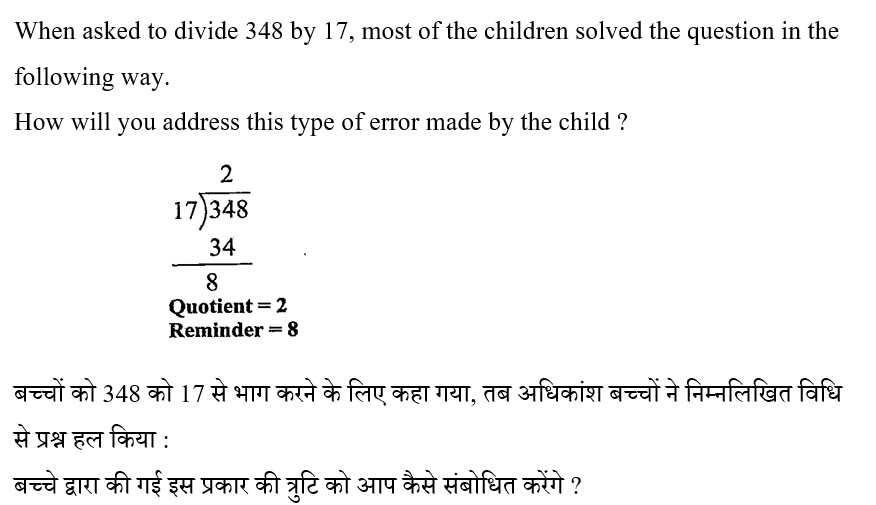
Provide them more such examples for practice./ उन्हें अभ्यास के लिए इसी प्रकार के और उदाहरण दें।
Help the child to use informal methods to estimate the answer./अनौपचारिक विधियों द्वारा उत्तर का अनुमान लगाने के लिए बच्चे की सहायता करें ।
Explain them the algorithm once again. /उन्हें कलन - विधि एक बार पुनः समझाएँ ।
Ask the child to recall the formula that connects dividend, divisor and remainder and then solve the problem. / भाज्य, भाजक और शेष में संबंध दिखाने और समस्या हल करने के लिए बच्चे को सूत्र स्मरण करने के लिए कहें ।
बच्चे द्वारा की गई प्रश्नगत त्रुटि के लिए अनौपचारिक विधियों द्वारा उत्तर का अनुमान लगाने के लिए बच्चे की सहायता करनी चाहिए। जबकि ऐसी त्रुटि के लिए अभ्यास के लिए इसी प्रकार के और उदाहरण देना कलन विधि को पुनः समझाना तथा भाज्य, भाजक और शेष में संबंध दिखाना एवं समस्या हल करने के लिए बच्चे को स्मरण करने के लिए कहना उपयुक्त संबोधन नहीं होगा। जब कोई बच्चा ऐसी त्रुटि करता है तो उसे उत्तर का अनुमान लगाने के लिए बच्चे की सहायता करना ही एक शिक्षक के लिए सर्वाधिक उपयुक्त संबोधन होगा।
Question 6:
For teaching mathematics at primary stage, the pedagogy should focus on
प्राथमिक स्तर पर गणित के शिक्षण के लिए, शिक्षाशास्त्र को केन्द्रित होना चाहिए
Didactic communication/उपदेशात्मक संप्रेषण पर
Drill and practice / ड्रिल एवं अभ्यास पर
Inductive approach / आगमनात्मक उपागम पर
Hypothesis generation and testing/ परिकल्पना सृजन एवं जाँच पर
प्राथमिक स्तर पर गणित के शिक्षण के लिए शिक्षा शास्त्र को आगमनात्मक उपागम पर आधारित होना चाहिए ।
क्योंकि प्राथमिक स्तर बुनियादी आयु होती है इसलिए इस स्तर पर उदाहरण से नियम की ओर चलते हैं। अर्थात् आगमनात्मक विधि का उपयोग करते है।
Question 7:
In a mathematics test, 'what is the formula of simple interest?' is an example of _____ based question.
गणित के टेस्ट में, 'साधारण ब्याज का सूत्र क्या है ?', _____पर आधारित प्रश्न का उदाहरण है।
Knowledge / ज्ञान
Understanding/बोध
Skill / कौशल
Application/अनुप्रयोग
ज्ञान (Knowledge) सूचना और समझ का एक निकाय हैं जो किसी व्यक्ति या समूह के पास होता है यह तथ्यों सिद्धान्तों या कौशल के रूप में हो सकता है। ज्ञान, अनुभव, शिक्षा, या अनुसंधान के माध्यम से प्राप्त किया जा सकता है इसका उपयोग समस्याओ को हल करने निर्णय लेने और आस-पास की दुनिया को समझने के लिए होता हैं।
अतः गणित के टेस्ट में साधारण ब्याज का सूत्र क्या है। ज्ञान पर आधारित प्रश्न का उदाहरण हैं।
Question 8:
Individuals are assessed by comparing their performance or performance or score against their own previous performance or score in :
व्यक्तियों का उनके स्वयं के पिछले प्रदर्शन या स्कोर के सापेक्ष उनके प्रदर्शन या अंकों की तुलना की जाती है।
Norm-Referenced Assessment/सामान्य-संदर्भित आकलन में
Benchmark Assessment / बेंचमार्क आकलन में
Criterion - Referenced Assessment/ मानदंड - संदर्भित आकलन में
Ipsative Assessment / इप्सेटिव आकलन में
इप्सेटिव असेसमेंट छात्र की प्रगति का मूल्यांकन करने का एक तरीका है। जिसमें मूल्यांकन और फीडबैक प्रथाओं की एक विस्तृत श्रृंखला शामिल होती है।
अतः व्यक्तियों का उनके स्वयं के पिछले प्रदर्शन या स्कोर के सापेक्ष उनके प्रर्दशन या अंको की तुलना इप्सेटिव आकलन में की जाती है। जबकि बेंचमार्क आकलन एक परीक्षण या अन्य मूल्यांकन है जो छात्रों को पूरे वर्ष विभिन्न अंतरालों पर दिया जाता है।
Question 9:
Which among the following is the most appropriate activity for teaching the concept of money in daily life to primary class students?
निम्नलिखित में से कौन-सा क्रियाकलाप, प्राथमिक कक्षाओं के विद्यार्थियों को दैनिक जीवन में मुद्रा अवधारणा के शिक्षण के लिए सर्वाधिक उपयुक्त है?
A. Organising a role play/भूमिका निर्वहन आयोजित करना
B. Visiting a nearby market / समीप के बाजार जाकर
C. Teaching the rules of conversion for different types of money/विभिन्न प्रकार के मुद्रा परिवर्तन के नियमों के शिक्षण द्वारा
D. Using an algorithm / कलन विधि का उपयोग करना
Choose the correct option:
सही विकल्प का चयन कीजिए :
C and D/C और D
Only C / केवल C
A and B / A और B
B and D/B और D
प्राथमिक कक्षाओं के विद्यार्थियों को दैनिक जीवन में मुद्रा अवधारणा के शिक्षण के लिए सर्वाधिक उपयुक्त विधि निम्नलिखित हैं-
(1) भूमिका निर्वहन आयोजित करना जैसे - एक व्यक्ति द्वारा मुद्रा को सही तरह से मैनेज कर खर्च करना एक भूमिका के रूप में बच्चों को दिखाता है।
(2) बच्चों को बाजार ले जाकर वहाँ की गतिविधियों से परिचित करा कर मुद्रा का सदुपयोग करने की अवधारणा प्रदान करना ।
Question 10:
What is the 'Higher Aim' of teaching mathematics according to National Curriculum Framework, 2005?
राष्ट्रीय पाठ्यचर्या रूपरेखा, 2005 के अनुसार गणित के शिक्षण का 'उच्च लक्ष्य' क्या है?
To help learner to acquire social and moral values to lead a fruitful life in the society शिक्षार्थियों को समाज में एक सफल जीवन जीने के लिए सामाजिक एवं नैतिक मूल्यों को अपनाने में मदद करना ।
To prepare the learners for technical professions / शिक्षार्थियों को तकनीकी व्यवसायों के लिए तैयार करना ।
To help learner to develop reasoning and critical thinking skills/शिक्षार्थियों को विवेचन एवं तर्कसंगत चिंतन कौशलों के विकास में मदद करना ।
To develop life-skills related to livelihood among learners/शिक्षार्थियों में रोजगार संबंधित जीवन - कौशलों का विकास करना ।
राष्ट्रीय पाठ्यचर्या रूपरेखा 2005 के अनुसार गणित के शिक्षण का 'उच्च लक्ष्य' शिक्षार्थियों को विवेचन एवं तर्कसंगत चिंतन कौशलों के विकास में मदद करना हैं। जिसका अर्थ है । कि बच्चों की विचार प्रक्रिया का गणितीकरण करना ।