मादाओं में अंडाणु उत्पादन की प्रक्रिया को क्या कहा जाता है ?
What is the process of production of ovum in the females called
अंडजनन / Oogenesis
रजोदर्शन / Menarche
कैशोर / Adolescence
ऋतुस्राव / Menstruation
व्याख्या- मादाओं में अंडाणु उत्पादन की प्रक्रिया को अंडजनन कहते हैं। अंडाशय स्त्री के प्राथकि लैंगिक अंग हैं जो स्त्री युग्मक (अंडाणु / ओवम) और कई स्टेरॉयड हार्मोन ( अंडाशयी हार्मोन) उत्पन्न करते हैं ।
Question 2:
निम्न में से कौन सी धातु मुक्त अवस्था में पाई जाती है?
Which of the following metals is found in free state ?
सोना / Gold
पोटैशियम / Potassium
सोडियम / Sodium
कैल्शियम / Calcium
व्याख्या- प्रश्न में दिये विकल्प के अनुसार सोना ( Gold ) धातु मुक्त अवस्था में पाई जाती है। सोना तन्य (Ductile ) धातु है ।
Question 3:
निम्न में से किसकी कमी से रिकेट्स बीमारी होती है?
Rickets is caused due to the deficiency of:
विटामिन / Vitamin D
विटामिन / Vitamin B
विटामिन / Vitamin A
विटामिन / Vitamin C
व्याख्या - विटामिन D की कमी से रिकेट्स जैसी बिमारी होती है। विटामिन D की सहायता से कैल्शियम को शरीर में बनाए रखने में मदद मिलती है, जो हड्डियों की मजबूती के लिए अति आवश्यक है।
Question 4:
निम्न में से कौन अधिक काम कर सकता है ?
Which of the following can do more work?
एक उठाया हुआ हथौड़ा / A raised hammer
एक घूमता हुआ पहिया / A rotating wheel
बंदूक की एक चलती हुई गोली / A moving bullet
गतिशील पत्थर/ A speeding stone
व्याख्या- प्रश्न में दिये गये विकल्प के अनुसार बंदूक की एक चलती हुई गोली अधिक कार्य कर सकता है, क्योंकि इसमें विस्थापन ज्यादा होगा।
Question 5:
नीचे के विकल्पों में तत्वों के किसी खास लक्षण और उनके आवर्त में बाएं से दायें और समूह में ऊपर से नीचे दिखने वाली विभिन्नता को निम्न रूप से दर्शाया गया
Given in the options are sets of particular characteristics of elements and how they vary across the period and down the group in the following format.
तत्व का लक्षण - आवर्त में बाएं से दायें - समूह में ऊपर से नीचे
Characteristic of an element - Across the period - Down the group.
सही विकल्प का चयन करें / Select the correct set from the given options.
विद्युत धनात्मकता / धात्विक लक्षण - घटता है / वृद्धि होती / Electropositve character metallic character - Decrease - increase
विद्युत धनात्मकता / धात्विक लक्षण - बढ़ता है / वृद्धि होती है घटता है / ह्रास होता है / Electropositive character metallic character - increase - Decrease
विद्युत धनात्मकता / धात्विक लक्षण - घटता है / ह्रास होता है घटता है / ह्रास होता है / Electropositive character metallic character - Decrease Decrease
विद्युत धनात्मकता / धात्विक लक्षण - बढ़ता है / वृद्धि होती है बढ़ता है / वृद्धि होती है / Electropositive character metallic character - increase - increase
व्याख्या- तत्व का लक्षण - विद्युत धनात्मक
आवर्त में बाएं से दायें - घटता है।
शमूह में ऊपर से नीचे - बढ़ता है ।
Question 6:
यांत्रिक ऊर्जा किसके बराबर है ?
Mechanical energy is equal to:
गतिज ऊर्जा + विद्युत ऊर्जा / Kinetic energy + Electrical energy
गतिज ऊर्जा + स्थितिज ऊर्जा / Kinetic energy+Potential energy
गतिज ऊर्जा + ऊष्मीय ऊर्जा / Kinetic energy+Heat energy
गतिज ऊर्जा + रासायनिक ऊर्जा / Kinetic energy+Chemical energy
तीव्र अम्ल और मंद क्षार से /Strong acid and weak base
तीव्र अम्ल और तीव्र क्षार से / Strong acid and strong base
मंद अम्ल और तीव्र क्षार से/ Weak acid and strong base
मंद अम्ल और मंद क्षार से/ Weak acid and weak base
व्याख्या - Nacl एक लवण है, जो तीव्र अम्ल और तीव्र क्षार से बनता है ।
Question 8:
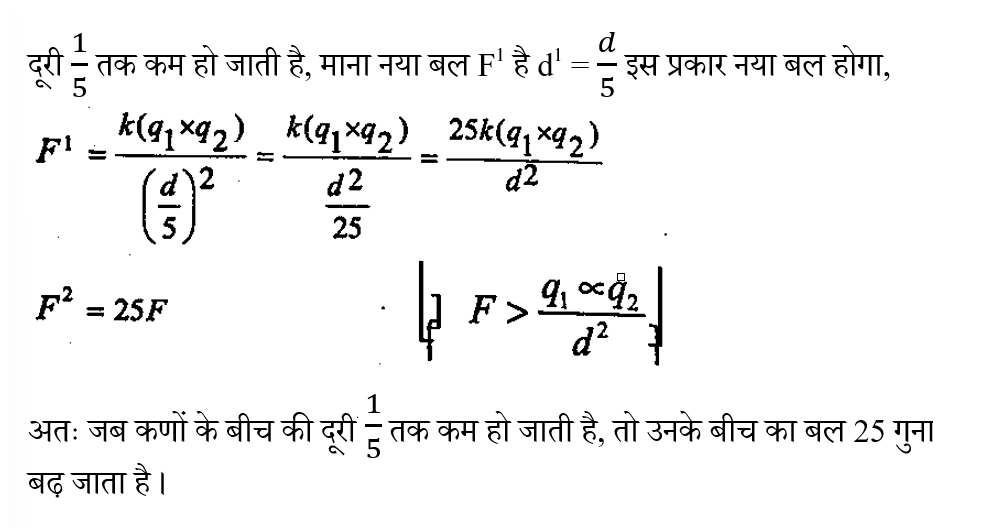
दो कण जिनका आवेश 11 और 12 है, एक दूसरे से कुछ दूरी पर रखे गये हैं। इनके बीच एक बल F उत्पन्न होता है । यदि दूरी में 1/5 की कमी की जाती है, तो दोनों के बीच बल कितना होगा?
Two particles with charges q1 and q2 are kept at a certain distance to exert force F on each other. If the distance is reduced to one-fifth, then the force between them is:
F/5
25F
5F
F/25
Question 9:
मटर के पौधे में पाया जाने वाला गुण निम्नलिखित में से कौन सा नहीं है ?
Which of the following characters is recessive in a pea plant?
गोल बीज / Round Seed
झुर्रीदार बीज / Wrinkled seed
हरी फली /Green pod
गोल फली / Round pod
व्याख्या- ग्रेगर मेंडल के अनुसार, मटर के पौधे में झुर्रीदार बीज आवर्ती नहीं होते हैं।
Question 10:
Which of the following forms an irreversible complex with haemoglobin of blood?
निम्नांकित में से कौन-सा रक्त के हीमोग्लोबिन के साथ अनुत्क्रमणीय संश्लिष्ट बनाता है?
शुद्ध नाइट्रोजन गैस Pure nitrogen gas
कार्बन डाइ - ऑक्साइड और हीलियम का मिश्रण A mixture of carbon dioxide and helium
कार्बन मोनोऑक्साइड Carbon monoxide
कार्बन डाइ - ऑक्साइड Carbon dioxide
व्याख्या : कार्बन मोनों ऑक्साइड (CO) एक जहरीली गैस है जो मुख्यतः मोटर गाड़ी के ईंधन जलने पर निकलती है यह रक्त के हीमोग्लोबिन के साथ मिलकर कार्बोक्सी हीमोग्लोबिन बनाता है जो शरीर के विभिन्न भागों में ऑक्सीजन के प्रवाह को रोकता है अन्ततः इससे आदमी की मौत हो सकती है। ज्ञातव्य है कि हीमोग्लोबिन एक लाल रक्त कण के कोशिका द्रव्य में एक प्रोटीन वर्णक और लोहा से बनता है। इसका मुख्य कार्य रक्त संचालन क्रिया के दौरान फुफ्फुस से O2 ग्रहण करना है और आक्सीहीमोग्लोबिन में बदल जाता है तथा पुनः ऊत्तको तक पहुंचने पर ऑक्सीजन अलग हो जाता है। ऊतक ऑक्सीजन ग्रहण कर लेते हैं अर्थात् O2 के संचालन का कार्य करता है।