
Question 1: 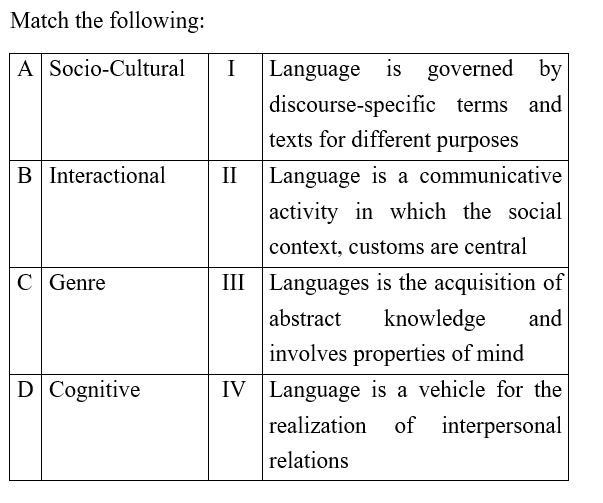
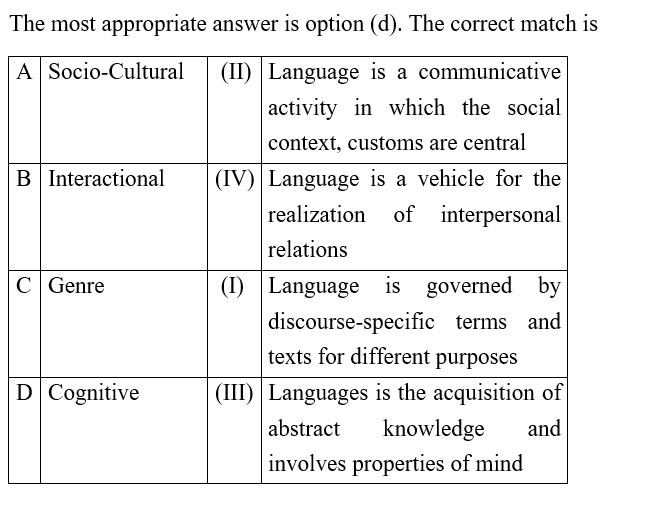
Question 2:
A language teacher tells a story in English and asks learners to work in group to tell the story in the languages known to them and then in the common language of the classroom. What is this pedagogical strategy known as?
Question 3:
Procedural knowledge in the teaching-learning grammar is ___________.
Question 4:
Shreya is a Class VI learner who moves from the Jalander in Punjab to Madurai in Tamil Nadu as her father has been transferred. She knows Punjabi as her mother tongue and English language she studies as her second language in school. She is able to speak and read Tamil learning from her neighborhood. Which one of the following statements is true based on the languages she now knows?
Question 5:
A learner reads through the news item in the newspaper to know specific information. This reading is known as _____.
Question 6:
एकः बालकः स्वनिकटपरिवेशे आंग्लभाषां शृणोति । स प्रायः स्वप्रथमभाषायां अस्याः शब्दावलिं प्रयोजयति एतद् अस्ति
Question 7:
निम्नलिखितेषु कः प्रयोगः तात्कालिकलेखकेभ्यः लेखनतत्परतया सम्बद्धः नास्ति ?
Question 8:
भाषाविकासस्य सम्बन्धे किं कथनं निम्नलिखितेषु सत्यम् अस्ति ?
Question 9:
Directions: Read the passage given below and answer the questions that follow by selecting the correct/most appropriate option.
1. A majority of people think that their dream job is too hard to achieve, too competitive and believe that it is all a matter of luck. All this is true actually, but why should that stop anyone from trying to get the job they really want? A really determined person will always succeed and, in many ways, will need other people to give up trying so that he can succeed.
2. Many job seekers feel limited by the choices they made at college. They may think that because they studied marketing, all they can ever do is work in marketing. All the evidence shows that, in fact, employers are less interested in acquired knowledge than the ability to think and learn. It is also very difficult to predict the needs of society. For example, if a person I chose to study dentistry because there was a lack of dentists when he was in high school, that may not be the case when he graduates. The needs of employers and the economy can change very very quickly, and often unexpectedly.
3. Of course, if it is a very tough time economically, it is hard to find employment straight after university, but it is by no means impossible. It might take several months longer to find a job after graduating, but there is work out there. A really key piece of advice is never to get downhearted by rejection because there will probably be a lot you can do to achieve your dream job, whatever it is. You must never give up. Be prepared to work hard and for long hours without necessarily climbing up the career ladder. There is a lot to be said for learning your trade from the bottom up. At the start, there will probably be little money, but it will be worth it in the end. The best jobs are not supposed to be easy – that is what makes them challenging. And if you like a challenge, just keep your head down and go for it.
A job seeker who likes challenges should keep his head down. This means he should ____________.
Question 10:
Directions: Read the passage given below and answer the questions that follow by selecting the correct/most appropriate option.
1. A majority of people think that their dream job is too hard to achieve, too competitive and believe that it is all a matter of luck. All this is true actually, but why should that stop anyone from trying to get the job they really want? A really determined person will always succeed and, in many ways, will need other people to give up trying so that he can succeed.
2. Many job seekers feel limited by the choices they made at college. They may think that because they studied marketing, all they can ever do is work in marketing. All the evidence shows that, in fact, employers are less interested in acquired knowledge than the ability to think and learn. It is also very difficult to predict the needs of society. For example, if a person I chose to study dentistry because there was a lack of dentists when he was in high school, that may not be the case when he graduates. The needs of employers and the economy can change very very quickly, and often unexpectedly.
3. Of course, if it is a very tough time economically, it is hard to find employment straight after university, but it is by no means impossible. It might take several months longer to find a job after graduating, but there is work out there. A really key piece of advice is never to get downhearted by rejection because there will probably be a lot you can do to achieve your dream job, whatever it is. You must never give up. Be prepared to work hard and for long hours without necessarily climbing up the career ladder. There is a lot to be said for learning your trade from the bottom up. At the start, there will probably be little money, but it will be worth it in the end. The best jobs are not supposed to be easy – that is what makes them challenging. And if you like a challenge, just keep your head down and go for it.
What advice does the writer not give employment seekers in para 3?