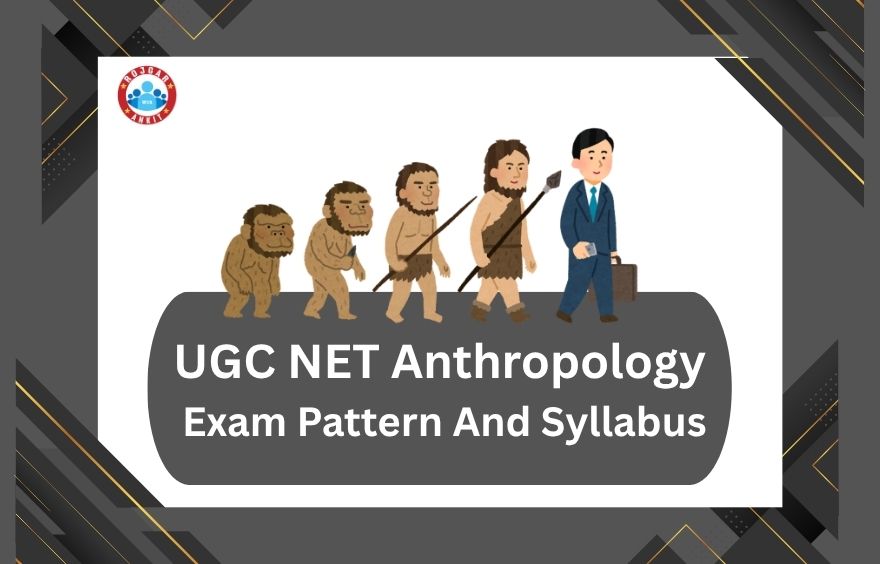
UGC NET Anthropology Exam Pattern And Syllabus

Ugc Net

The UGC NET Anthropology Exam is a national-level eligibility test conducted by the National Testing Agency on behalf of the University Grants Commission for candidates aspiring to become Assistant Professors and Junior Research Fellows (JRF) in Anthropology. The examination evaluates a candidate’s understanding of human evolution, socio-cultural anthropology, archaeology, biological anthropology, tribal studies, and research methodology. It is conducted in Computer-Based Test (CBT) mode and consists of two papers — Paper 1, which tests teaching and research aptitude, and Paper 2, which focuses entirely on Anthropology subjects.

The exam is highly important for students seeking academic and research careers in universities and colleges across India. UGC NET Anthropology provides opportunities in teaching, field research, museum studies, social welfare organizations, and governmental research institutions. Candidates preparing for the exam should focus on conceptual clarity, previous year papers, and updated syllabus topics to achieve good scores and qualify successfully.

UGC NET Anthropology: Overview Table 

ParticularsDetails
Organization NameUniversity Grants Commission (UGC)
Exam Conducting Body NameNational Testing Agency (NTA)
Exam NameUGC-NET June 2026
Subject NameAnthropology (Subject Code: 07)
Selection ProcessComputer Based Test (CBT)
Official WebsiteClick Here

UGC NET Anthropology: Exam Pattern 

ParticularsDetails
Total Questions150 Questions (Part I: 50 MCQs, Part II: 100 MCQs)
Total Marks300 Marks (Part I: 100 Marks, Part II: 200 Marks)
Exam Duration180 minutes (03 hours) without any break between Paper 1 & Paper 2
DurationThe total duration of the exam is 03 hours (180 minutes).
No BreaksThere is no break between Part I and Part II; the exam runs continuously.
Compulsory QuestionsAll 150 questions are compulsory.
Marks per QuestionEach correct response carries 02 (two) marks.
Negative MarkingThere is no negative marking for incorrect responses.
Unattempted QuestionsNo marks will be given for questions left unanswered, unattempted, or marked for review.

UGC NET: Paper 1 Exam Pattern

UnitSubject AreaNumber of Questions (Approx.)Total Marks
Unit 1Teaching Aptitude510
Unit 2Research Aptitude510
Unit 3Comprehension510
Unit 4Communication510
Unit 5Mathematical Reasoning and Aptitude510
Unit 6Logical Reasoning510
Unit 7Data Interpretation510
Unit 8Information and Communication Technology (ICT)510
Unit 9People, Development and Environment510
Unit 10Higher Education System510
TotalOverall Paper 150 Questions100 Marks

UGC NET Paper 2 for Anthropology (Subject Code: 07) 

UnitSubject/Topic FocusExpected Number of QuestionsMarks
Unit IFundamentals of Anthropology, History, Branches, & Research Methodology1020
Unit IIHuman Evolution, Primatology, & Theories of Evolution1020
Unit IIIModern Human Variation, Ethnic Classification, & Population Genetics1020
Unit IVHuman Growth, Development, Maturation, & Modes of Inheritance1020
Unit VConcept of Prehistoric Archaeology & Theoretical Paradigms1020
Unit VIPrehistoric Cultures of India (Palaeolithic, Mesolithic, Neolithic)1020
Unit VIISocial-Cultural Anthropology (Society, Culture, Family, Marriage, Kinship)1020
Unit VIIIAnthropological Theories, Economic, Political, & Legal Anthropology1020
Unit IXDevelopment of Indian Anthropology, Early Anthropologists, & Concepts1020
Unit XTribal Situation in India, Rural Development, & Applied Anthropology1020
TotalComplete Paper 2 Syllabus100 Questions200 Marks

UGC NET Anthropology: Syllabus

Part I: General Paper (Common for All Subjects)

UnitSubject AreaDetailed Topics Covered
Unit ITeaching AptitudeTeaching concept, objectives, levels of teaching (memory, understanding, reflective); Learner characteristics (adolescent and adult learners); Factors affecting teaching; Methods of teaching in higher learning institutions (teacher-centered vs. learner-centered, offline vs. online); Teaching support systems (traditional, modern, ICT-based); Evaluation systems and Choice Based Credit System (CBCS).
Unit IIResearch AptitudeResearch meaning, types, and characteristics; Positivism and post-positivistic approach; Methods of research (experimental, descriptive, historical, qualitative, quantitative); Steps of research; Thesis and article writing (format and referencing styles); Application of ICT in research; Research ethics.
Unit IIIComprehensionA passage of text is provided. Candidates must answer questions based on their understanding and analysis of the passage.
Unit IVCommunicationCommunication meaning, types, and characteristics; Effective communication (verbal, non-verbal, intercultural, group, classroom); Barriers to effective communication; Mass-media and society.
Unit VMathematical Reasoning and AptitudeTypes of reasoning; Number series, letter series, codes, and relationships; Mathematical aptitude (fractions, time & distance, ratio, proportion, percentage, profit and loss, interest, discounting, averages).
Unit VILogical ReasoningUnderstanding the structure of arguments (premises, deductive/inductive reasoning); Evaluating and distinguishing arguments; Venn diagrams; Analogies; Indian Logic: Means of knowledge (Pramanas, Pratyaksha, Anumana, Upamana, Shabda, Arthapatti, Anupalabdhi); Structure and kinds of Anumana (inference), Vyapti, Hetvabhasas.
Unit VIIData InterpretationSources, acquisition, and classification of data; Quantitative and qualitative data; Graphical representation (bar-chart, histograms, pie-chart, table-chart, line-chart) and mapping of data; Data interpretation; Data and governance.
Unit VIIIInformation and Communication Technology (ICT)ICT general abbreviations and terminology; Basics of the Internet, Intranet, E-mail, Audio and Video-conferencing; Digital initiatives in higher education; ICT and governance.
Unit IXPeople, Development and EnvironmentDevelopment and environment (Millennium and Sustainable Development Goals); Human and environment interaction (anthropogenic activities); Environmental issues (air, water, soil, noise pollution, climate change); Impacts of pollutants on human health; Natural and energy resources; Natural hazards and disasters; Environmental Protection Act (1986), National Action Plan on Climate Change, International agreements (Kyoto Protocol, Paris Agreement, International Solar Alliance).
Unit XHigher Education SystemInstitutions of higher learning and education in ancient India; Evolution of higher learning and research in post-independence India; Oriental, conventional, and non-conventional learning programs; Professional, technical, and skill-based education; Value education and environmental education; Policies, governance, and administration.

UGC NET Paper 2 for Anthropology (Subject Code: 07) 

UnitDetailed Syllabus Topics
Unit I
  • History, Development, and Scope: History, development, aim and scope of Anthropology, relationship with other sciences, different branches of Anthropology (including Linguistic Anthropology) and their interrelationship.
  • Research Methodology and Methods: Concepts of epistemology, ontology and theoretical perspectives. Types of research (qualitative and quantitative), research design, hypothesis. Fieldwork and fieldwork tradition; Ethnography, Observation, Interview, Case Study, Life History, Focus group, PRA, RRA, Genealogical Method, Schedules and Questionnaires, Grounded Theory, Exploration and Excavation, GIS.
  • Statistics: Concept of variables, sampling, measures of central tendency and dispersion, parametric and nonparametric bivariate and multivariate (linear regression and logistic regression) statistical tests.
  • Techniques of Analysis: Content analysis, Discourse analysis and Narratives.
Unit II
  • Evolutionary Theories: Lamarckism, Neo-Lamarckism, Darwinism, Neo-Darwinism, Synthetic theory, neutral theory of molecular evolution, concept of cladogenesis and anagenesis, punctuated equilibrium, selection.
  • Primatology: Trends in Primate radiation; Primate classification and distribution of extinct and extant species. Characteristics of primates: morphological (hair), skeletal (cranial, post cranial, dental, brain), physical (opposability of thumb), locomotion (quadrupedalism, brachiation and bipedalism) and posture, Primate social behaviour. Extant Primates (Prosimii, Anthropoidea) and morphological/anatomical characteristics of Human, Chimpanzee, Gorilla, Orangutan and Gibbon. Fossils of extinct Primates: Oligocene-Miocene fossils (Parapithecus; Gigantopithecus, Aegyptopithecus, Dryopithecus, Ramapithecus and Sivapithecus).
  • Hominid Evolution: Pre-hominid groups (Sahelanthropus tchadensis, Orrorin tugenensis, Ardipithecus ramidus). Early Hominids (Australopithecus species). Early Transitional Human (Homo habilis). Characteristics and distribution of Homo erectus (Turkana boy, Java man, Peking man, Dmanisi, Homo floresiensis). Archaic sapiens (Homo heidelbergensis, Rhodesian Man, Jinniushan, Narmada Man). Neandertal man (Distribution, features, phylogeny). Anatomically Modern Homo sapiens (Omo, Cro-magnon, Chancelade, Grimaldi, Jinniushan, Lake Mungo). Dispersal hypotheses (Out of Africa, Multiregional, Partial Replacement).
Unit III
  • Human Variation and Classification: Typological, Populational and Clinal Models; overview of Classification by Blumenbach, Deniker, Hooton, Coon, Garn and Birdsell. Ethnic Classification and distribution of Indian Populations (H.H. Risley; B. S. Guha; S. S. Sarkar). Linguistic distribution of ethnic groups.
  • Human Genetics: Cytogenetics, Mendelian Genetics, Twin Genetics, Sib Pair methods, Population Genetics, Molecular Genetics. Cytogenetics (cell cycle, standard karyotyping, banding techniques, chromosomal abnormalities, FISH, Lyon’s hypothesis, telomere and centromere importance). Linkage, chromosome mapping, genetic imprinting.
  • Modes of Inheritance: Autosomal, sex-linked, sex-influenced, sex-limited, modifying/suppressor/selfish genes, multiple allelic, multifactorial, and polygenic inheritance (dermatoglyphics, indices, ridge counts, palmar formulas, flexion creases).
  • Population & Molecular Genetics: Hardy-Weinberg equilibrium; mating patterns, inbreeding coefficient, genetic load, genetic isolate, genetic drift, genetic distance; genetic polymorphism. DNA, RNA, genetic code, RFLPs, VNTRs, STRs, SNPs, Mitochondrial DNA, genic/genomic mutations.
Unit IV
  • Human Growth and Development: Basic principles, prenatal and postnatal phases of growth. Growth curves (Velocity, Distance, Acceleration, Scammon’s curve), Catch up and Catch down growth. Aging and senescence (somatic, skeletal, dental maturation). Factors affecting growth (Genetic, Environmental, Secular trends). Methods of studying human growth (Longitudinal, Cross-sectional, Mixed, Linked). Body composition.
  • Human Adaptation: Allen’s and Bergmann’s rule; Human Adaptability Programme; adaptation to heat, cold, high altitude.
  • Somatotyping & Demography: Concept and Development (Kretschmer, Sheldon, Parnoll, Health-Carter). Multidisciplinary nature of demography; Fertility, Morbidity, mortality, Migration (concepts and determinants); Selection intensity.
Unit V
  • Prehistoric Archaeology Concepts: Ethno-archaeology, experimental, environmental, settlement, cognitive, geo-archaeology, action archaeology. Theoretical paradigms.
  • Dating Methods: Typology, seriation, geo-archaeological, obsidian, hydration, chemical dating, oxygen isotope, fluorine, dendrochronology, radio-carbon, fission track, thermo-luminescence, potassium-argon, varve clay, cross dating, amino acid racemization, palaeomagnetic.
  • Paleoenvironment: Major geological stages and climatic changes (glacial/interglacial, ice age, pluvial phases). Evidences of quarternary climatic changes. Site formation.
  • Lithic Tool Typology/Technology & Cultures: Lower Palaeolithic (pebble tools, bifaces, handaxes, cleavers); Middle Palaeolithic (flake/core tools, scrapers, points); Upper Palaeolithic (blades, knives, burins); Mesolithic (microliths); Neolithic (celt, adze, ring stones). Overview of European Lithic Cultures (Acheulian, Mousterian, Perigordian, Magdalenian, etc.). Early Farming Cultures of the Near East (Jericho, Jarmo, Çatal Huyuk, Shanidar).
Unit VIPrehistoric Cultures of India:

  • Lower Palaeolithic: Pebble tool culture (Soan); Acheulian culture (Madrasian, Bhimbetka, Narmada valley, Hathnora).
  • Middle Palaeolithic: Belan valley, Bhimbetka, Nevasa, Narmada valley.
  • Upper Palaeolithic: Renigunta, Billa Surgam, Patne, Bhimbetka, Son/Belan Valleys.
  • Mesolithic: Economy, society, Post Pleistocene changes, microlithic technology. Sites: Bagor, Tilwara, Langhnaj, Bhimbetka, Sarai Nahar Rai.
  • Neolithic: Consequences of food production, settlements, craft specialization. Sites: Burzahom, Gufkral, Ahar, Navdatoli, Daimabad, Inamgaon, Brahmagiri, Nagarjunakonda.
  • Cave Art: Bhimbetka, Adamgarh.
  • Indus Civilization & Later Ages: Village expansion, metal technology, art, architecture. Sites: Amri, Kot Diji, Kalibangan, Mohenjodaro, Harappa, Lothal, Dholavira. Pottery Traditions (OCP, Black and Red ware, PGW, NBP). Bronze/Copper Age, Iron Age, and Urban Revolution. Megaliths (menhir, dolmen, topical, cist, cairn circle, sarcophagi).
Unit VIIConceptual Understanding of Social Anthropology:

  • Culture & Society: Attributes, Holism, Acculturation, Enculturation, Culture Shock, Cultural Relativism, Great/Little Tradition. Groups, Institutions, Status and Role. Incest, Endogamy, Exogamy, Rites of passage.
  • Social Institutions: Family (types, rules of residence, functions, changes). Marriage (types, functions, marital transactions, bride price, dowry). Kinship (Descent, terminology, matrilineal puzzle, clan, lineage).
  • Economic Anthropology: Theories (Malinowski, Formal, Substantivist, Marxist), Livelihoods, subsistence, division of labour, Exchange, reciprocity, Kula, Potlatch, Jajmani.
  • Legal & Political: Anthropology of Law, Social Sanctions. Political processes in band, tribe, chiefdom, state; Conflicts, Nations, democracy.
  • Religion & Belief: Animism, animatism, totemism, taboo, religious specialists, Magic, Rituals
  • Social Change: Assimilation, Integration, Syncretism.
Unit VIII
  • Theories in Social Anthropology: Evolutionism (Tylor, Morgan, Fraser, Maine); Diffusionism; Historical Particularism (Boas); Functionalism (Malinowski); Structural-Functionalism (Radcliffe-Brown, Firth, Parsons); Structuralism (Levi-Strauss); Culture and Personality (Mead, Benedict, Linton); Cultural Ecology/Neo-evolutionism (Leslie White, Julian Steward); Cultural Materialism (Marvin Harris); Symbolic Anthropology (Victor Turner, Mary Douglas); Cognitive Anthropology; Deep Ethnography (Clifford Geertz); Anthropology and Gender; Postmodernism/Poststructuralism (Foucault, Derrida, Bourdieu); Ethnicity (Barth, Jeffery, Weber).
Unit IX
  • Indian Anthropology: Stages in the Development of Indian Anthropology. Concepts: Social Stratification (Caste), SC, Dalit, OBC, Nomadic Groups. Revivalist/Nativist movements, Peasant movements. Tribe, ST, PVTGs, Tribal movements (Birsa, Naga), Tribal Development. Indian Village Studies (S.C. Dube, McKim Marriott, M.N. Srinivas). Constitutional Safeguards for SC/ST, Panchayati Raj Institutions, SHGs. Theoretical ideas: Sanskritization, Westernization, Modernization, Sacred Complex, Nature-Man-Spirit Complex. Early Indian Anthropologists (G.S. Ghurye, B.S. Guha, S.C. Roy, L.P. Vidyarthi, M.N. Srinivas, N.K. Bose, D.N. Majumdar, etc.).
Unit X
  • Applied and Action Anthropology: Concepts and Theories: Applied, Action, Engaged, Experimental, Urban, Public, Medical, Visual, Business, and Forensic Anthropology; Genomic Studies, Genetic Counseling, Ergonomics, Kinanthropometry.
  • Development & Interventions: Community Development Projects (Rural, Urban, Tribal); Revisits, Re-studies, Social Impact Assessment (SIA)
  • Anthropological Approaches: Public health, education, nutrition, land alienation, bonded labour, housing, gender issues, relief, rehabilitation, identity crisis, aging. Development Strategies (Plan/Sub Plan). Role of NGOs in Development. Empowerment of Women, LGBT groups.

Preparation Tips

  1. Capitalize on the Marking Scheme Each correct answer in the examination awards you 2 marks. More importantly, there is absolutely no negative marking for incorrect responses. Your primary strategy should be to attempt all 150 questions across both papers. Never leave a question blank or merely ‘Marked for Review’ without selecting a final option, as unanswered questions yield zero marks.
  2. Master the CBT Interface & Navigation The exam is strictly a Computer Based Test (CBT). It is vital to familiarize yourself with the interface, especially the navigation buttons. To finalize an answer, you MUST click on the “Save & Next” button. If you are unsure and want to revisit a question, you can use the “Mark for Review & Next” button. However, remember that answers placed under “Marked for Review” will only be considered for evaluation if you have actually selected a response.
  3. Target the Minimum Qualifying Marks Before aiming for the top percentiles, ensure your preparation covers enough ground to secure the minimum aggregate marks required to be considered for the merit list. You must secure at least 40% aggregate marks in both papers taken together if you are in the General/General-EWS category, and at least 35% aggregate marks if you belong to a reserved category (SC, ST, OBC-NCL, PwD, PwBD, or Third gender).
  4. Effective Time Management You have exactly 180 minutes to solve 150 questions with no breaks. The on-screen computer clock counter will display a countdown timer in the top right corner of your screen, showing the time remaining. Keep a close eye on this timer. Allocate your time wisely between the General Aptitude section (Paper 1) and the heavily weighted Anthropology section (Paper 2) to ensure you don’t run out of time.
  5. Utilize Official Mock Tests To build muscle memory for the exam day, utilize the official CBT Guidelines provided by the NTA. Practice extensively using the Mock Test link provided by the NTA (https://www.nta.ac.in/Quiz). This will help you get comfortable with selecting, deselecting, and reviewing answers efficiently

Some Important Links : 

HPSC PGT Computer Science Admit Card 2026 OutClick Here to Read
UKSSSC Livestock Extension Officer Notification 2026Click Here to Read
UP Home Guard Answer Key 2026 OutClick Here to Read
UP SI Result 2026 OutClick Here to Read
CUET UG Admit Card 2026 OutClick Here to Read
RSSB Lab Assistant Admit Card 2026 OutClick Here to Read
RRB NTPC UG Admit Card 2026 OutClick Here to Read

Leave a Reply

Your email address will not be published. Required fields are marked *

Index
Scroll to Top
Rajasthan Forts Made Simple for Exams Interesting Facts About Rajasthan’s First Governor UPSI Aspirants Shocked by Normalisation Difference UPSSSC Sugarcane Supervisor Vacancy 2026 Out RWA Guru Mantra Series for UP Police Aspirants