
Question 1:
Direction : Answer the questions based on the information given below.
निर्देश : नीचे दी गई जानकारी के आधार पर प्रश्नों के उत्तर दें।
In a certain code of language, एक निश्चित कूट भाषा में,
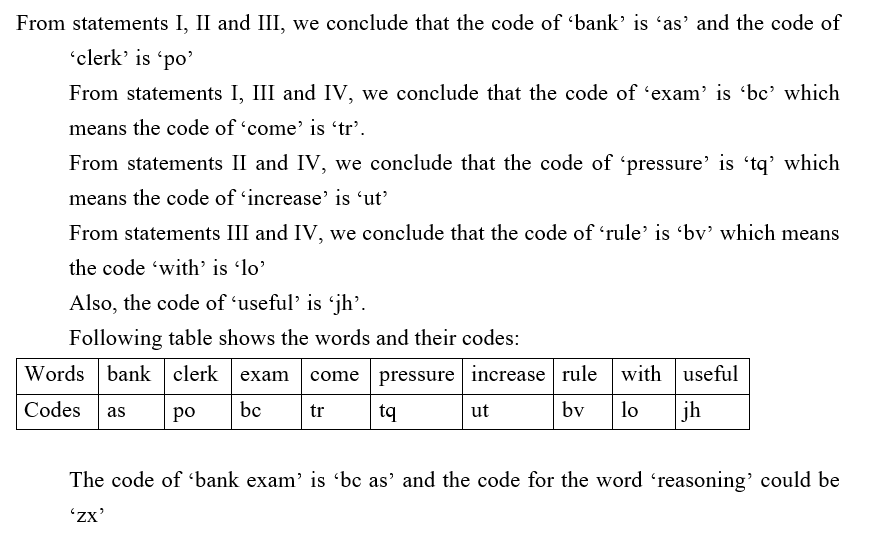
I. ‘bank clerk exam come’ is coded as ‘as bc po tr’
I. ‘bank clerk exam come’ का कूट है 'as bc po tr'
II. ‘pressure clerk increase bank’ is coded as ‘po ut tq as’
II. ‘pressure clerk increase bank’ का कूट है 'po ut tq as'
III. ‘with exam bank rule’ is coded as ‘bv bc as lo’
III. ‘with exam bank rule’ का कूट है 'bv bc as lo'
IV. ‘pressure rule exam useful’ is coded as ‘tq jh bc bv’
IV. ‘pressure rule exam useful’ का कूट है 'tq jh bc bv'
What could be the code for ‘reasoning bank exam?.
‘reasoning bank exam' के लिए क्या कूट हो सकता है?
Question 2:
Directions : Answer the questions based on the information given below:
निर्देश : दिए गए जानकारी के आधार पर सवालों के उत्तर दें।
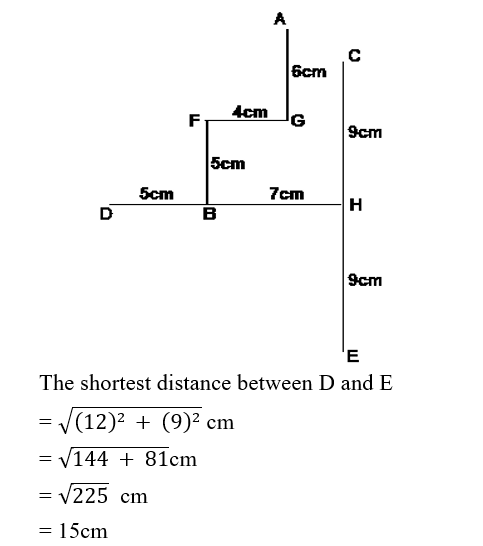
Eight points are drawn on a sheet of paper such that A is 6cm north of G. H is 9cm south of C. D is 5cm west of B. H is 7cm east of B. H is exactly in the middle of C and E. F is 5cm north of B. G is 4cm east of F.
आठ बिन्दुओं को एक कागज़ पर इस तरह बनाया जाता है कि A, G के 6 सेमी उत्तर में है। H, C के 9 सेमी दक्षिण में है। D, B के 5 सेमी पश्चिम में है। H, B के 7 सेमी पूर्व में है। C और E के ठीक मध्य में H है। F, B के 5 सेमी उत्तर में है। G, F के 4 सेमी पूर्व में है।
What is the shortest distance between D and E?
D और E के बीच की न्यूनतम दूरी कितनी है?
Question 3:
Directions : Answer the questions based on the information given below:
निर्देश : दिए गए जानकारी के आधार पर सवालों के उत्तर दें।
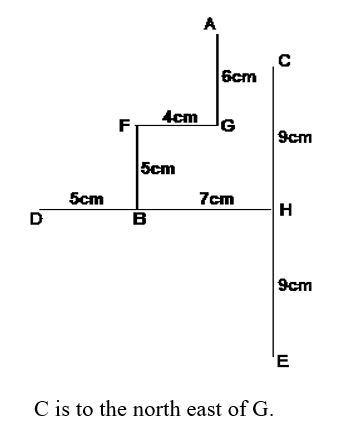
Eight points are drawn on a sheet of paper such that A is 6cm north of G. H is 9cm south of C. D is 5cm west of B. H is 7cm east of B. H is exactly in the middle of C and E. F is 5cm north of B. G is 4cm east of F.
आठ बिन्दुओं को एक कागज़ पर इस तरह बनाया जाता है कि A, G के 6 सेमी उत्तर में है। H, C के 9 सेमी दक्षिण में है। D, B के 5 सेमी पश्चिम में है। H, B के 7 सेमी पूर्व में है। C और E के ठीक मध्य में H है। F, B के 5 सेमी उत्तर में है। G, F के 4 सेमी पूर्व में है।
What is the direction of C with respect to G?
G के सन्दर्भ में C किस दिशा में है?
Question 4:
Direction : In the question below there are three statements followed by two conclusions I and II. You have to take the three given statements to be true even if they seem to be at variance from commonly known facts and then decide which of the given conclusions logically follows from the three statements disregarding commonly known facts.
निर्देश : निम्नलिखित प्रश्न में तीन कथन के बाद दो निष्कर्ष I और II दिए गए हैं।आपको दिए गए कथनों को सत्य मानना है भले ही वह ज्ञात तथ्यों से भिन्न भी हो और फिर यह तय करना है कि दिए गए निष्कर्षों में से कौन सा निष्कर्ष इन कथनों का तर्कसंगत अनुसरण करता है।
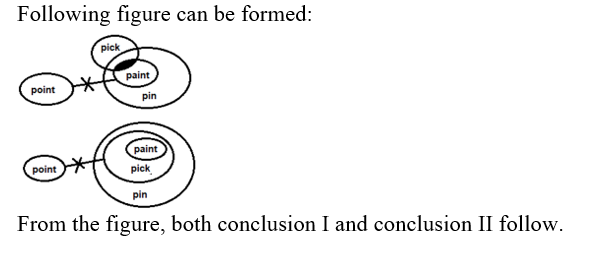
Statements: No point is paint
कथन: कोई भी पॉइंट पेंट नहीं है
All paint is pin
सभी पेंट पिन है
Only a few pick is paint
Conclusions: I. All paint being pick is a possibility
निष्कर्ष: I. सभी पेंट के पिक होने की एक संभावना है
II. Some pick is not point
II. कुछ पिक पॉइंट नहीं है
Question 5:
Direction : In the question below there are three statements followed by two conclusions I and II. You have to take the three given statements to be true even if they seem to be at variance from commonly known facts and then decide which of the given conclusions logically follows from the three statements disregarding commonly known facts.
निर्देश : निम्नलिखित प्रश्न में तीन कथन के बाद दो निष्कर्ष I और II दिए गए हैं।आपको दिए गए कथनों को सत्य मानना है भले ही वह ज्ञात तथ्यों से भिन्न भी हो और फिर यह तय करना है कि दिए गए निष्कर्षों में से कौन सा निष्कर्ष इन कथनों का तर्कसंगत अनुसरण करता है।
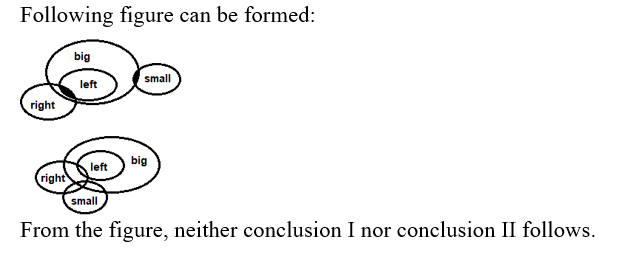
Statements: Only a few right is left
कथन: केवल कुछ राईट लेफ्ट है
Every left is big
प्रत्येक लेफ्ट बिग है
Only a few small is big
केवल कुछ स्माल बिग है
Conclusions: I. All small being big is a possibility
निष्कर्ष: I. सभी स्माल के बिग होने की एक संभावना है।
II. No right is small
II. कोई भी राईट स्माल नहीं है
Question 6:
Direction : In the question below there are three statements followed by two conclusions I and II. You have to take the three given statements to be true even if they seem to be at variance from commonly known facts and then decide which of the given conclusions logically follows from the three statements disregarding commonly known facts.
निर्देश : निम्नलिखित प्रश्न में तीन कथन के बाद दो निष्कर्ष I और II दिए गए हैं।आपको दिए गए कथनों को सत्य मानना है भले ही वह ज्ञात तथ्यों से भिन्न भी हो और फिर यह तय करना है कि दिए गए निष्कर्षों में से कौन सा निष्कर्ष इन कथनों का तर्कसंगत अनुसरण करता है।
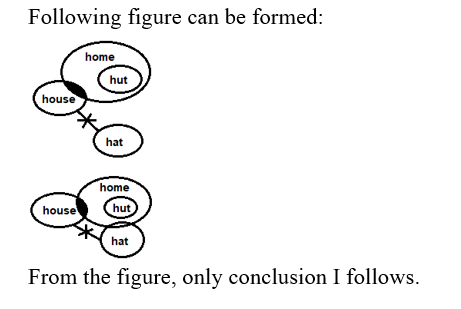
Statements: No hat is house
कथन: कोई भी हैट हाउस नहीं है
Only a few house is home
केवल कुछ हाउस होम है
Only home is hut
केवल होम हट है
Conclusions: I. Some home being hat is a possibility
निष्कर्ष: I. कुछ होम के हैट होने की एक संभावना है
II. A few hut can be house
II. कुछ हट हाउस हो सकते है
Question 7:
Direction : In the question, assuming the given statements to be true, find which of the conclusion (s) among given three conclusions is /are definitely true and then give your answer accordingly.
निर्देश : निम्नलिखित प्रश्न में, दिए गए कथनों को सत्य मानकर, यह तय करना है कि दिए गए निष्कर्षों में से कौन सा निष्कर्ष निश्चित रूप से सत्य है और फिर उसी अनुसार अपना उत्तर दें।
Statements: S < 7 = 8; U < S ≤ T; U < 8 ≤ 9
Conclusions: I. U < 9 II. T > U
III. 7 > T
Question 8:
Direction : In the question, assuming the given statements to be true, find which of the conclusion (s) among given three conclusions is /are definitely true and then give your answer accordingly.
निर्देश : निम्नलिखित प्रश्न में, दिए गए कथनों को सत्य मानकर, यह तय करना है कि दिए गए निष्कर्षों में से कौन सा निष्कर्ष निश्चित रूप से सत्य है और फिर उसी अनुसार अपना उत्तर दें।
Statements: A ≤ C ≥ B; C ≤ D < E; G > E ≤ F
Conclusions: I. A ≤ F II. G > B
III. F > D
Question 9:
Direction : In the question, assuming the given statements to be true, find which of the conclusion (s) among given three conclusions is /are definitely true and then give your answer accordingly.
निर्देश : निम्नलिखित प्रश्न में, दिए गए कथनों को सत्य मानकर, यह तय करना है कि दिए गए निष्कर्षों में से कौन सा निष्कर्ष निश्चित रूप से सत्य है और फिर उसी अनुसार अपना उत्तर दें।
Statements: K < 2 ≤ 8; 1 > K = 3 < L; 8 > B ≥ 5
Conclusions: I. 1 > 8 II. L > B
III. 3 < 8
Question 10:
Direction : In the question, assuming the given statements to be true, find which of the conclusion (s) among given three conclusions is /are definitely true and then give your answer accordingly.
निर्देश : निम्नलिखित प्रश्न में, दिए गए कथनों को सत्य मानकर, यह तय करना है कि दिए गए निष्कर्षों में से कौन सा निष्कर्ष निश्चित रूप से सत्य है और फिर उसी अनुसार अपना उत्तर दें।
Statements: 5 ≥ Z<T; P<T ≤ I; 5<X ≤ V
Conclusions: I. V>Z II. I >X
III. P<5