
Question 1:
Direction : In the question below there are three statements followed by two conclusions I and II. You have to take the three given statements to be true even if they seem to be at variance from commonly known facts and then decide which of the given conclusions logically follows from the three statements disregarding commonly known facts.
निर्देश : निम्नलिखित प्रश्न में तीन कथन के बाद दो निष्कर्ष I और II दिए गए हैं।आपको दिए गए कथनों को सत्य मानना है भले ही वह ज्ञात तथ्यों से भिन्न भी हो और फिर यह तय करना है कि दिए गए निष्कर्षों में से कौन सा निष्कर्ष इन कथनों का तर्कसंगत अनुसरण करता है।
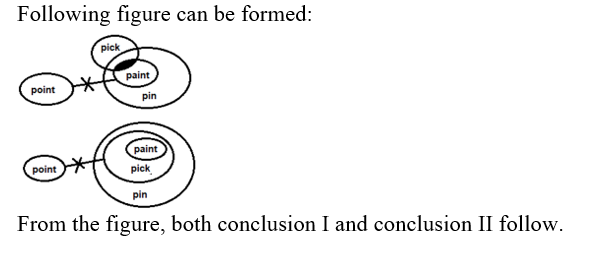
Statements: No point is paint
कथन: कोई भी पॉइंट पेंट नहीं है
All paint is pin
सभी पेंट पिन है
Only a few pick is paint
Conclusions: I. All paint being pick is a possibility
निष्कर्ष: I. सभी पेंट के पिक होने की एक संभावना है
II. Some pick is not point
II. कुछ पिक पॉइंट नहीं है
Question 2:
Direction : In the question below there are three statements followed by two conclusions I and II. You have to take the three given statements to be true even if they seem to be at variance from commonly known facts and then decide which of the given conclusions logically follows from the three statements disregarding commonly known facts.
निर्देश : निम्नलिखित प्रश्न में तीन कथन के बाद दो निष्कर्ष I और II दिए गए हैं।आपको दिए गए कथनों को सत्य मानना है भले ही वह ज्ञात तथ्यों से भिन्न भी हो और फिर यह तय करना है कि दिए गए निष्कर्षों में से कौन सा निष्कर्ष इन कथनों का तर्कसंगत अनुसरण करता है।
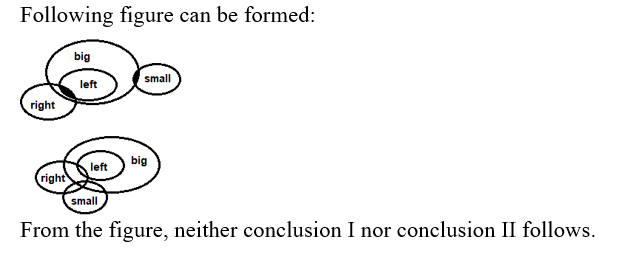
Statements: Only a few right is left
कथन: केवल कुछ राईट लेफ्ट है
Every left is big
प्रत्येक लेफ्ट बिग है
Only a few small is big
केवल कुछ स्माल बिग है
Conclusions: I. All small being big is a possibility
निष्कर्ष: I. सभी स्माल के बिग होने की एक संभावना है।
II. No right is small
II. कोई भी राईट स्माल नहीं है
Question 3:
Direction : In the question below there are three statements followed by two conclusions I and II. You have to take the three given statements to be true even if they seem to be at variance from commonly known facts and then decide which of the given conclusions logically follows from the three statements disregarding commonly known facts.
निर्देश : निम्नलिखित प्रश्न में तीन कथन के बाद दो निष्कर्ष I और II दिए गए हैं।आपको दिए गए कथनों को सत्य मानना है भले ही वह ज्ञात तथ्यों से भिन्न भी हो और फिर यह तय करना है कि दिए गए निष्कर्षों में से कौन सा निष्कर्ष इन कथनों का तर्कसंगत अनुसरण करता है।
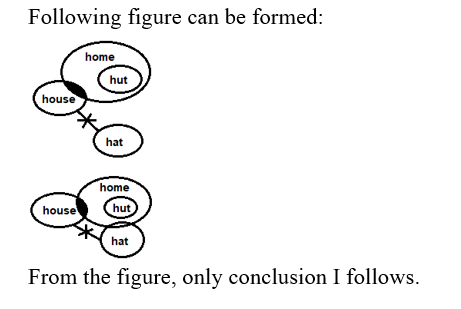
Statements: No hat is house
कथन: कोई भी हैट हाउस नहीं है
Only a few house is home
केवल कुछ हाउस होम है
Only home is hut
केवल होम हट है
Conclusions: I. Some home being hat is a possibility
निष्कर्ष: I. कुछ होम के हैट होने की एक संभावना है
II. A few hut can be house
II. कुछ हट हाउस हो सकते है
Question 4:
Direction : In the question, assuming the given statements to be true, find which of the conclusion (s) among given three conclusions is /are definitely true and then give your answer accordingly.
निर्देश : निम्नलिखित प्रश्न में, दिए गए कथनों को सत्य मानकर, यह तय करना है कि दिए गए निष्कर्षों में से कौन सा निष्कर्ष निश्चित रूप से सत्य है और फिर उसी अनुसार अपना उत्तर दें।
Statements: S < 7 = 8; U < S ≤ T; U < 8 ≤ 9
Conclusions: I. U < 9 II. T > U
III. 7 > T
Question 5:
Direction : In the question, assuming the given statements to be true, find which of the conclusion (s) among given three conclusions is /are definitely true and then give your answer accordingly.
निर्देश : निम्नलिखित प्रश्न में, दिए गए कथनों को सत्य मानकर, यह तय करना है कि दिए गए निष्कर्षों में से कौन सा निष्कर्ष निश्चित रूप से सत्य है और फिर उसी अनुसार अपना उत्तर दें।
Statements: A ≤ C ≥ B; C ≤ D < E; G > E ≤ F
Conclusions: I. A ≤ F II. G > B
III. F > D
Question 6:
Direction : In the question, assuming the given statements to be true, find which of the conclusion (s) among given three conclusions is /are definitely true and then give your answer accordingly.
निर्देश : निम्नलिखित प्रश्न में, दिए गए कथनों को सत्य मानकर, यह तय करना है कि दिए गए निष्कर्षों में से कौन सा निष्कर्ष निश्चित रूप से सत्य है और फिर उसी अनुसार अपना उत्तर दें।
Statements: K < 2 ≤ 8; 1 > K = 3 < L; 8 > B ≥ 5
Conclusions: I. 1 > 8 II. L > B
III. 3 < 8
Question 7:
Direction : In the question, assuming the given statements to be true, find which of the conclusion (s) among given three conclusions is /are definitely true and then give your answer accordingly.
निर्देश : निम्नलिखित प्रश्न में, दिए गए कथनों को सत्य मानकर, यह तय करना है कि दिए गए निष्कर्षों में से कौन सा निष्कर्ष निश्चित रूप से सत्य है और फिर उसी अनुसार अपना उत्तर दें।
Statements: 5 ≥ Z<T; P<T ≤ I; 5<X ≤ V
Conclusions: I. V>Z II. I >X
III. P<5
Question 8:
Directions : Answer the questions based on the information given below.
निर्देश : नीचे दी गई जानकारी के आधार पर प्रश्नों के उत्तर दें।
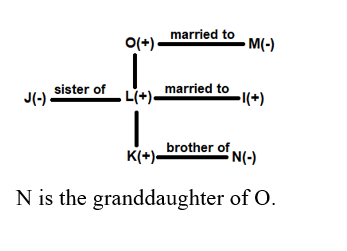
There are seven-members and three generations in a family. There is no single parent. There are only two married couples. I is the sister-in-law of J. K is the son of L. M is the grandmother of N. O is the paternal grandfather of K. J is an unmarried female. L has only one daughter.
एक परिवार में सात सदस्य और तीन पीढ़ियाँ हैं।कोई एकल अभिवावक नहीं है। केवल दो विवाहित जोड़े हैं। I, J की साली/ननद/भाभी है। K, L का पुत्र है। M, N की दादी/नानी है। O, K का दादा है। J एक अविवाहित महिला है। L की केवल एक पुत्री है।
How is N related to O?
N O से कैसे सम्बंधित है?
Question 9:
Rakesh, Rinki and Rakhi start a business by investing ₹33120, ₹x and ₹36800, respectively. At the end of year, profit share of Rinki is 20% less than the profit share of Rakhi and profit share of Rakesh is equal to the average profit of Rinki and Rakhi. If at the end of year, profit share of Rakhi is ₹920 then find the value of ‘x’.
राकेश, रिंकी और राखी ने क्रमशः 33120, रु.x और रु.36800 का निवेश करके एक व्यवसाय शुरू करते हैं। वर्ष के अंत में, रिंकी का लाभ हिस्सा राखी के लाभ हिस्से से 20% कम है और राकेश का लाभ हिस्सा रिंकी और राखी के लाभ के औसत के बराबर है। यदि वर्ष के अंत में, राखी का लाभ हिस्सा रु.920 है तो 'x' का मान ज्ञात कीजिए।
Question 10:
After 4 years, ratio of age of ‘A’ to ‘B’ will be 2:3 respectively. Age of ‘B’, 2 years ago was 80% more than age of ‘A’, 6 years ago. If present average age of ‘B’ and ‘C’ is 48 years, then find ratio of present age of ‘A’ to ‘C’.
4 वर्ष बाद, 'A' की आयु और 'B' की आयु का अनुपात क्रमशः 2:3 होगा। 2 वर्ष पहले 'B' की आयु, 6 वर्ष पहले 'A' की आयु से 80% अधिक थी। यदि 'B' और 'C' की वर्तमान औसत आयु 48 वर्ष है, तो 'A' और 'C' की वर्तमान आयु का अनुपात ज्ञात कीजिए।