Uttar Pradesh Public Service Commission (UPPSC) द्वारा RO/ARO Recruitment 2026 का Notification जारी कर दिया गया है| इस भर्ती के तहत कुल 501 Vacancies पर योग्य Candidates का Selection किया जाएगा| Exam की तैयारी करने वाले Candidates के लिए UPPSC RO/ARO Exam Pattern और Syllabus को समझना जरूरी है| Exam Pattern और Syllabus की मदद से Candidates परीक्षा में शामिल Subjects, Questions के प्रकार और Important Topics को समझ सकते हैं| इससे उन्हें अपनी Preparation को सही दिशा देने और परीक्षा के अनुसार Study Strategy बनाने में मदद मिलती है|
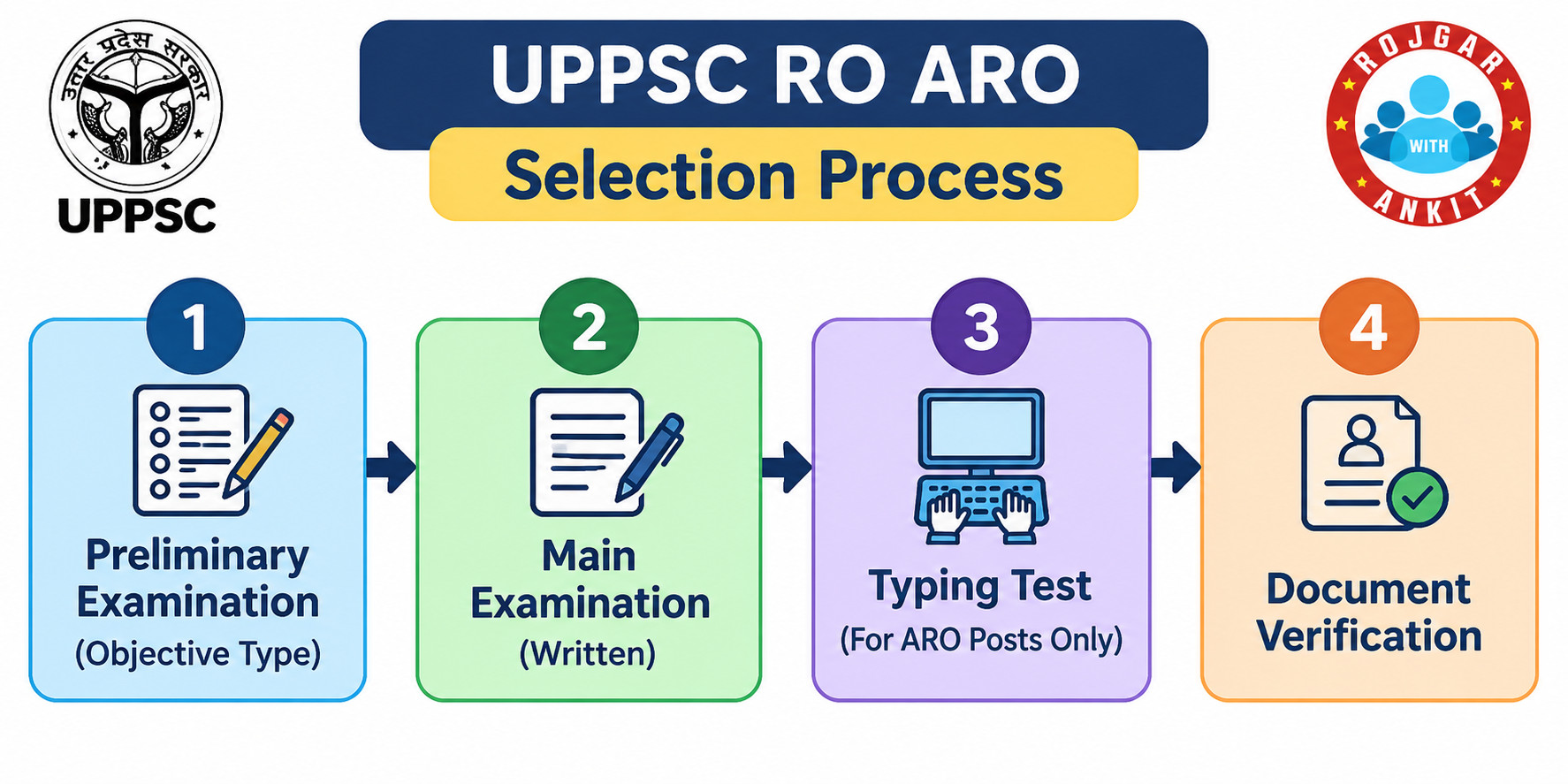
UPPSC RO/ARO Selection Process में Preliminary Examination, Main Examination और पद के अनुसार Skill Test शामिल है| प्रत्येक Stage का अपना अलग Pattern और Requirements होती हैं| इसलिए Candidates के लिए सभी Stages की जानकारी होना जरूरी है, ताकि वे परीक्षा के अनुसार अपनी तैयारी कर सकें|
नीचे दी गई Table में आप UPPSC RO/ARO Exam Pattern और Syllabus 2026 का Overview देख सकते हैं| इसमें Preliminary Examination, Main Examination, Papers की संख्या, Exam Duration और Marks Distribution जैसी महत्वपूर्ण जानकारी दी गई है| इससे Candidates को परीक्षा के Pattern और Syllabus को समझने में मदद मिलेगी और वे अपनी Preparation को बेहतर तरीके से Plan कर सकेंगे|
UPPSC RO/ARO Prelims Exam में कुल 2 Papers होते हैं, जिनमें General Studies और General Hindi शामिल हैं| Candidates को दोनों Papers के लिए अलग-अलग समय दिया जाता है| नीचे दिए गए Table में Exam Pattern की पूरी जानकारी दी गई है|
Paper
Subject
Number of Questions
Maximum Marks
Duration
Paper 1
General Studies
140
140
2 Hours
Paper 2
General Hindi
60
60
1 Hour
Total
–
200
200
180 minutes (3 Hours)
General Hindi Marks Distribution:
S. No.
Topics
Number of Questions
1
Opposites
10
2
Sentences and Correction in Framing
10
3
One Word for Several Words
10
4
Same Uses and Same Nature Words
10
5
A Noun as Defined by an Adjective and Adjectives
10
6
Synonymous Words
10
UPPSC RO/ARO 2026 : Mains Exam Pattern
Preliminary परीक्षा के परिणाम के आधार पर Vacancies की संख्या से 15 गुना Candidates को Main Exam के लिए Shortlist किया जाएगा। Qualified Candidates को Mains Exam के लिए अलग से Online Application Form भरना होगा। Mains परीक्षा में Preliminary Exam वाला Same रोल नंबर ही Use होगा। नीचे दी गई टेबल में हमने मुख्य परीक्षा का पूरा पैटर्न दिया है, जिसमें पेपर के Type, अंक और समय की जानकारी है।
Paper
Name Of Paper
Type
Maximum Marks
Time
1
General Studies-I
Conventional
200
3 Hours
2
General Studies-II
200
3 Hours
3
General Hindi And Composition
200
3 Hours
4
Hindi Essay
200
3 Hours
Total
800
Important Details:
Papers 1 And 2:10 Short-Answer Questions (8 Marks Each; Word Limit: 75 Words) And 10 Long-Answer Questions (12 Marks Each; Word Limit: 125 Words).
Paper 3: 8 Questions, With Internal Choices In Some Questions.
Paper 4: Two Essays- First Essay: 80 Marks (Word Limit: 800 Words); Second Essay: 120 Marks (Word Limit: 1,200 Words).
Mains Exam Marks Distribution:
Paper
Question No.
Topic
Marks Distribution
Total Marks
General Hindi And Composition
1
Unseen Passage: Title, Explanation Of Three Underlined Parts, And Précis
5 + 15 + 10
30
2
(a) Summary Of A Government Letter In Tabular Form
10
10
(b) Correspondence: Official Letter, Semi-Official Letter, Office Order, Circular, Reminder, Office Memorandum, Press Note, Noting, And Report
10 + 10
20
3
(a) Technical Terminology: Hindi To English Translation
10
10
(b) Technical Terminology: English To Hindi Translation
10
10
4
Idioms And Proverbs: Meaning And Use In Sentences (10 Questions)
10 × 3
30
5
(a) Grammar: Noun, Pronoun, Adjective, Case, And Verb
5 × 3
15
(b) Punctuation Marks
5
5
(c) Error Correction: Spelling Errors And Sentence Errors
5 + 5
10
6
Hindi Letters: Vowels, Consonants, And Their Classification
10
10
7
(a) Hindi Word Categories: Tatsam, Tadbhav, Deshaj, And Foreign Words
10
10
(b) Hindi Word Formation: Prefix, Suffix, Sandhi, And Samas
10
10
(c) Vocabulary: Synonyms, Antonyms, Multiple-Meaning Words, One-Word Substitutions, And Similar-Sounding Words With Different Meanings
20
20
8
General Knowledge Of Computers
10
10
Paper Total
200
Hindi Essay
Section 1
Science, Environment And Technology
Economic Sector
Agriculture, Industry And Trade
Natural Disasters
1 Essay × 80 Marks
80
Section 2
Literature And Culture
Social And Political Sphere
National And International Events
National Development Schemes And Projects
1 Essay × 120 Marks
120
Paper Total
2 Essays (One From Each Section)
200
Grand Total
General Hindi And Composition + Hindi Essay
400 Marks
UPPSC RO/ARO 2026 : Prelims Syllabus
UPPSC RO/ARO Prelims Exam की तैयारी करने वाले Candidates को सभी Subjects के Syllabus की जानकारी होनी चाहिए| इससे उन्हें Important Topics को समझने और अपनी Preparation को सही तरीके से Plan करने में मदद मिलती है| नीचे General Studies और General Hindi का पूरा Syllabus दिया गया है|
Subject
Topics
General Studies
General Science
History of India
Indian National Movement
Indian Polity, Economy and Culture
Indian Agriculture, Commerce and Trade
Population, Ecology and Urbanisation (in the Indian Context)
World Geography and Geography and Natural Resources of India
Current National and International Important Events
General Intelligentsia
Special Knowledge Regarding Education, Culture, Agriculture, Industry, Trade, Living and Social Traditions of Uttar Pradesh
General Hindi
Opposites
Sentences and Correction in Framing
One Word for Several Words
Same Uses and Same Nature Words
A Noun as Defined by an Adjective and Adjectives
Synonymous Words
UPPSC RO/ARO 2026 : Mains Syllabus
UPPSC RO/ARO Mains Exam में Candidates को General Studies, General Hindi and Composition और Hindi Essay के Papers देने होंगे| हर Paper का Exam Pattern, Duration और Marks अलग-अलग हैं| Candidates नीचे दिए गए Table में Mains Exam के Syllabus और Marks Distribution की पूरी जानकारी Check कर सकते हैं|
Paper
Topics
Paper-I: General Studies-I
Indian History, Art And Culture
Indian Art, Culture, Literature And Architecture From Ancient To Modern Times
Modern Indian History (1757- 1947): Important Events And Personalities
Indian Freedom Struggle: Stages And Contributions From Different Regions
Post-Independence Consolidation And Reorganisation Of India (Up To 1965)
Indian Society
Features Of Indian Society And Culture
Role Of Women And Women’s Organisations
Population-Related Issues
Urbanisation: Problems And Solutions
Liberalisation, Privatisation And Globalisation: Meaning And Social Effects
Social Empowerment, Social Justice And Inclusive Growth
Geography Of India
Physical Geography: Structure, Physiography, Climate, Drainage, Soil And Vegetation
Economic Geography: Agriculture, Irrigation, Minerals, Energy Resources, Industries And Transport Networks
Human Geography: Population Structure, Composition, Distribution, Density And Growth
Rural And Urban Settlements: Types, Patterns And Metropolitan Growth
Physical, Human And Economic Geography Of Uttar Pradesh
Planning And Development Issues
Environment And Disaster Management
Environment And Types Of Ecosystems
Biotic And Abiotic Components
Energy Flow, Water Cycle, Carbon Cycle, Nitrogen Cycle And Biosphere
Human-Environment Relationship
Water, Air, Noise And Soil Pollution
Environmental Degradation, Conservation And Management
Environment Protection Act
Types Of Disasters: Volcanoes, Earthquakes, Tsunamis, Landslides, Glacial Avalanches, Floods, Droughts, Epidemics And Pandemics
Disaster Management Cycle: Preparation, Rescue, Relief And Reconstruction
Natural Hazards, Damage And Loss
Roles Of NDMA, NDRF And SDRF
Science And Technology
Science And Technology Developments And Their Applications In Everyday Life
Applications Of Physical, Chemical And Biological Sciences
India’s Science And Technology Policy, New Initiatives And International Collaborations
Satellite Communication, INSAT, Remote Sensing, Cryogenic Rockets And GPS
Space Technology And Its Role In Development
IT Industry, Information Technology, Display Technologies And Telecommunications
Missile Systems, Ballistic Missile Defence, UAVs And Stealth Technology
Chemical And Biological Weapons
Nanoscience, Nanotechnology And Nanomaterials: Applications And Impacts On Health And The Environment
Robotics And Artificial Intelligence: Applications And Unemployment Issues
Nuclear Energy Policy, Applications, Radiation And Radioactive Waste
Nuclear And Radiological Disasters
Biotechnology, Microbiology, Biopiracy, Bioinformatics And Ethical Issues
Paper-II: General Studies-II
Indian Polity And Constitution
Indian Constitution: Historical Background, Evolution, Features, Amendments, Important Provisions And Basic Structure
Role Of The Supreme Court In The Evolution Of Constitutional Provisions
Functions And Responsibilities Of The Union And State Governments
Federal Structure And Related Issues
Devolution Of Powers And Finances To Local Levels
Finance Commission And Centre-State Financial Relations
Parliament And State Legislatures: Structure, Functioning, Conduct Of Business, Powers And Privileges
Governance
Structure, Organisation And Functioning Of The Executive And Judiciary
Government Ministries And Departments
Pressure Groups And Formal And Informal Political Associations
Public Interest Litigation (PIL)
Constitutional Posts: Appointments, Powers, Functions And Responsibilities
Statutory, Regulatory And Quasi-Judicial Bodies
NITI Aayog: Features And Functioning
Government Policies And Development Interventions
Policy Design, Implementation And Information And Communication Technology (ICT)
Economy And Agriculture
Sustainable Development Goals (SDGs)
Manufacturing Sector: Challenges And Strategies
Energy Scenario And Transport Systems: Surface, Water And Air
Government Budget And Financial System
Effects Of Liberalisation And Globalisation On The Economy
Industrial Policies And Their Effects On Industrial Growth
Foreign Trade: Problems And Prospects
Major Agricultural Crops And Commercialisation Of Agriculture
Manures, Fertilisers, Irrigation Methods And Systems
Storage, Transportation And Marketing Of Agricultural Produce
E-Technology For Farmers
Direct And Indirect Farm Subsidies And Minimum Support Price (MSP)
Agricultural Diversity
Agricultural Problems And Their Solutions In Uttar Pradesh
Technology Missions In Agriculture
Ethics And Integrity
Ethics: Foundations, Characteristics And Normative Study Of Morality
Truth, Right, Good, Morality, Values, Ethics And Metaethics
Candidates Scoring Below The Prescribed Qualifying Marks Will Be Disqualified
Preparation Tips:
सभी Exam Topics को समय पर Cover करने के लिए एक Proper Timetable बनाएं|
Paper-I के Current Affairs की तैयारी के लिए Regularly Newspapers पढ़ें|
बेहतर तैयारी और पढ़ी हुई चीजों को याद रखने के लिए Revision को Priority दें|
अपनी Preparation को Evaluate करने और Exam Pattern को समझने के लिए Mock Tests दें और Previous Year Question Papers की Practice करें|
Get the Latest Government Job News First! Join Us Now!!
Frequently Asked Questions:
Q1. What Is The Negative Marking Scheme In The UPPSC RO ARO Exam?
Answer: One-Third (0.33) Of The Marks Assigned To A Question Will Be Deducted For Each Wrong Answer. No Marks Will Be Deducted For Unattempted Questions.
Q2. Which Pen Should Candidates Use To Fill The OMR Answer Sheet?
Answer: Candidates Must Use Only A Black Ballpoint Pen To Fill The OMR Answer Sheet. The Use Of Any Other Pen Or Pencil Is Prohibited.
Q3. What Should Candidates Do With The OMR Answer Sheet After The Examination?
Answer: Candidates Must Submit The Original OMR Answer Sheet To The Invigilator And Keep The Candidate’s Copy With Them.
Q4. What Is The Minimum Qualifying Standard For Different Categories?
Answer: The Minimum Efficiency Standard Is 35% For SC And ST Candidates And 40% For Candidates Of Other Categories. Candidates Scoring Below The Prescribed Standard Will Be Disqualified.