National Testing Agency (NTA) द्वारा Joint Entrance Examination (Mains) 2027 का आयोजन Undergraduate Engineering (B.E./B.Tech) और Architecture/Planning (B.Arch/B.Planning) courses में Admission के लिए किया जा रहा है। इस Examination के माध्यम से Candidates अपनी निर्धारित Educational Qualification के अनुसार Paper-1 (B.E./B.Tech), Paper-2A (B.Arch) या Paper-2B (B.Planning) में शामिल हो सकते हैं।
Marks संबंधित Subjects (Physics, Chemistry, Mathematics) और Aptitude/Drawing/Planning Competencies पर आधारित होंगे। इस Article में Candidates JEE Main 2027 का Overview, Selection Process, Exam Pattern, Marking Scheme और Syllabus से संबंधित जरूरी Details Check कर सकते हैं। Subject-Wise Preparation के लिए Candidates को अपने संबंधित Paper और Subject के Prescribed Curriculum पर Focus करना चाहिए।
JEE Main 2027 Exam Pattern : Overview
| Particulars | Details |
| Examination Name | Joint Entrance Examination (Main) 2027 |
| Conducting Board | National Testing Agency (NTA) |
| Examination Mode | Computer Based Test (CBT) |
| Post/Course Name | Undergraduate Engineering (B.E./B.Tech) & Architecture/Planning (B.Arch/B.Planning) |
| Selection Process | Computer Based Test (CBT) & JoSAA/CSAB Counselling |
| Official Website | https://jeemain.nta.nic.in/ |
JEE Main 2027 : Selection process
- Computer Based Test: Candidates को अपने Selected Paper-1, Paper-2A या Paper-2B के अनुसार Computer Based Examination देना होगा। Candidates Session 1 या Session 2 में से किसी एक या दोनों Sessions में शामिल हो सकते हैं।
- Result Declaration & NTA Score: Examination के बाद Multi-shift Normalization Process के आधार पर NTA Score और Common Rank List (CRL) जारी किया जाएगा।
- Counselling & Seat Allotment: JEE Main में Qualify करने वाले Candidates को JoSAA/CSAB Seat Allocation Process के तहत NITs, IIITs और CFTIs में Seats allot की जाएंगी।
- JEE (Advanced) Eligibility: Paper-1 के Top 2,50,000 Candidates IITs में Admission के लिए JEE (Advanced) Examination देने के पात्र होंगे।
| Note: JEE Main Qualify करना अपने आप में किसी Institute में Final Admission की Guarantee नहीं है। Admission के लिए संबंधित Institute द्वारा निर्धारित Educational Eligibility Criteria, State Quota और Document Verification Rules लागू होंगे। |
JEE Main 2027 : Exam Pattern
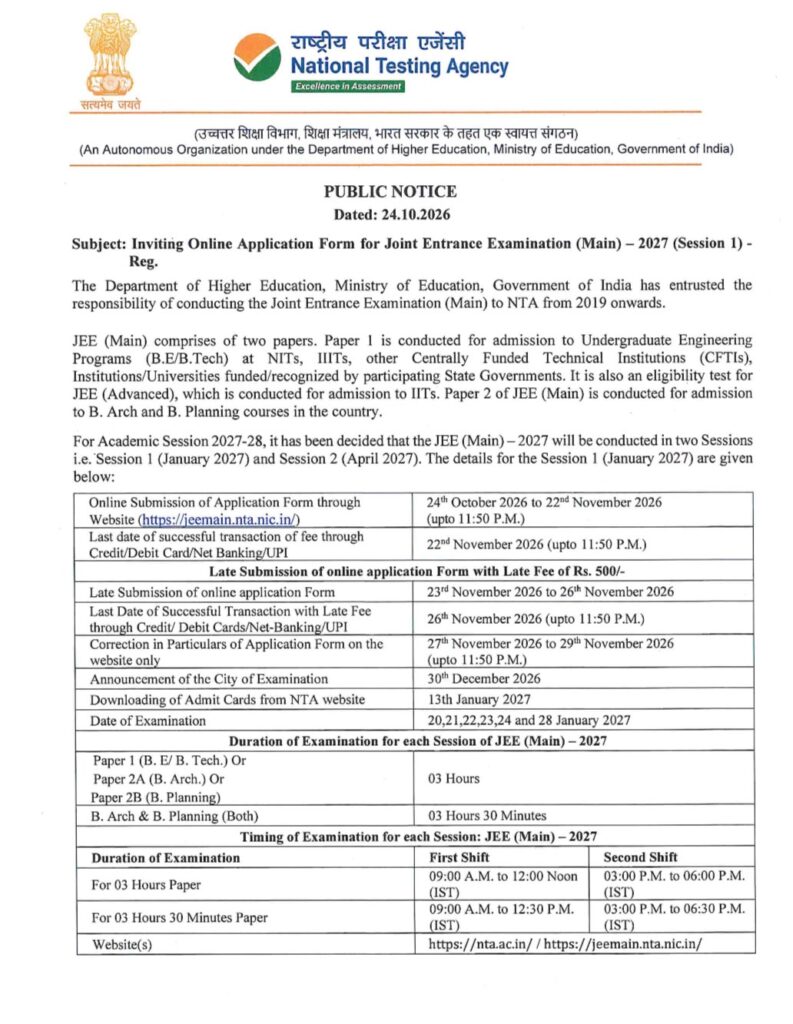
NTA JEE Main 2027 Session 1 के Exam Pattern में Shift Timings और Examination Duration की जानकारी नीचे दी गई है। Candidates अपनी Exam Preparation के लिए निर्धारित Timings और Duration Check कर सकते हैं।
JEE Main Exam Pattern 2027 Overview
| Particulars | Paper 1 (B.E./B.Tech) | Paper 2A (B.Arch) | Paper 2B (B.Planning) |
| Conducting authority | NTA | NTA | NTA |
| Exam mode | Computer-based test (CBT) | CBT and offline drawing test | CBT |
| Subjects | Mathematics, Physics, Chemistry | Mathematics, Aptitude, Drawing | Mathematics, Aptitude, Planning |
| Total questions | 75 | 77 | 100 |
| Total marks | 300 | 400 | 400 |
| Exam duration | 3 hours | 3 hours | 3 hours |
Shift Timings
| Paper Duration | First Shift | Second Shift |
(who are eligible for scribe) 04 hours | 09:00 A.M. to 12:00 Noon (IST) | 03:00 P.M. to 06:00 P.M. (IST) |
(who are eligible for scribe) 04 hours | 09:00 A.M. to 12:30 P.M. (IST) | 03:00 P.M. to 06:30 P.M. (IST) |
Paper-wise Scheme of Examination
Paper 1: B.E./ B. Tech. in Computer Based Test (CBT) mode
| Subject | Number of Questions: Section A | Number of Questions: Section B | Marks |
| Mathematics | 20 | 05 | 100 |
| Physics | 20 | 05 | 100 |
| Chemistry | 20 | 05 | 100 |
| Total | 75 | – | 300 |
Paper 2A (B. Arch): Mathematics (Part-I) and Aptitude Test (Part-II) in Computer Based Test (CBT) mode and Drawing Test (Part-III) in Pen and Paper Based (offline) mode, to be attempted on a drawing sheet of A4 size.
| Subject | Number of Questions | Marks |
| Part I: Mathematics | 20 (Section A) and 05 (Section B) | 100 |
| Part II: Aptitude test | 50 | 200 |
| Part III: Drawing Test | 02 | 100 |
| Total | 77 | 400 |
Paper 2B (B. Planning) Part-I: Mathematics, Part-II: Aptitude Test and Part-III: Planning- Based Questions in Computer-Based Test (CBT) mode.
| Subject | Number of Questions | Marks |
| Part-I: Mathematics | 20 (Section A) and 05 (Section B) | 100 |
| Part-II: Aptitude Test | 50 | 200 |
| Part-III: Planning | 25 | 100 |
| Total | 100 | 400 |
| Note: Paper 1 और Paper 2 के Part-I में प्रत्येक विषय में दो भाग होंगे। Section A में Multiple-Choice Questions (MCQs) होंगे और Section B में ऐसे प्रश्न होंगे जिनके उत्तर Numerical Value के रूप में भरने होंगे। Section A और Section B दोनों में गलत उत्तरों के लिए Negative Marking लागू होगी। |
JEE Main 2027 Exam Pattern : Marking Scheme
| Correct answer or the most appropriate answer: | (+4) |
| Any incorrect option marked will be given minus one mark | (-1) |

JEE Main 2027 Exam: Syllabus
JEE Main 2027 Paper 1 (B.E./B.Tech): Mathematics Syllabus
| Unit No. | Unit Name | Topics Covered |
| Unit 1 | Sets, Relations and Functions |
|
| Unit 2 | Complex Numbers and Quadratic Equations |
|
| Unit 3 | Matrices and Determinants |
|
| Unit 4 | Permutations and Combinations |
|
| Unit 5 | Binomial Theorem |
|
| Unit 6 | Sequence and Series |
|
| Unit 7 | Limit, Continuity and Differentiability |
|
| Unit 8 | Integral Calculus |
|
| Unit 9 | Differential Equations |
|
| Unit 10 | Coordinate Geometry |
|
| Unit 11 | Three Dimensional Geometry |
|
| Unit 12 | Vector Algebra |
|
| Unit 13 | Statistics and Probability |
|
| Unit 14 | Trigonometry |
|
Click Here to Download Syllabus PDF
JEE Main 2027 Paper 1 (B.E./B.Tech): Physics Syllabus
| Unit No. | Unit Name | Topics Covered |
| Unit 1 | Units and Measurements |
|
| Unit 2 | Kinematics |
|
| Unit 3 | Laws of Motion |
|
| Unit 4 | Work, Energy and Power |
|
| Unit 5 | Rotational Motion |
|
| Unit 6 | Gravitation |
|
| Unit 7 | Properties of Solids and Liquids |
|
| Unit 8 | Thermodynamics |
|
| Unit 9 | Kinetic Theory of Gases |
|
| Unit 10 | Oscillations and Waves |
|
| Unit 11 | Electrostatics |
|
| Unit 12 | Current Electricity |
|
| Unit 13 | Magnetic Effects of Current and Magnetism |
|
| Unit 14 | Electromagnetic Induction and AC |
|
| Unit 15 | Electromagnetic Waves |
|
| Unit 16 | Optics |
|
| Unit 17 | Dual Nature of Matter and Radiation |
|
| Unit 18 | Atoms and Nuclei |
|
| Unit 19 | Electronic Devices |
|
| Unit 20 | Experimental Skills |
|
JEE Main 2027 Paper 1 (B.E./B.Tech): Chemistry Syllabus
| Section | Unit No. | Unit Name | Topics Covered |
| Physical Chemistry | Unit 1 | Some Basic Concepts in Chemistry |
|
| Unit 2 | Atomic Structure |
| |
| Unit 3 | Chemical Bonding & Molecular Structure |
| |
| Unit 4 | Chemical Thermodynamics |
| |
| Unit 5 | Solutions |
| |
| Unit 6 | Equilibrium |
| |
| Unit 7 | Redox Reactions & Electrochemistry |
| |
| Unit 8 | Chemical Kinetics |
| |
| Inorganic Chemistry | Unit 9 | Classification of Elements & Periodicity |
|
| Unit 10 | p-Block Elements |
| |
| Unit 11 | d- and f-Block Elements |
| |
| Unit 12 | Coordination Compounds |
| |
| Organic Chemistry | Unit 13 | Purification & Characterisation |
|
| Unit 14 | Basic Principles of Organic Chemistry |
| |
| Unit 15 | Hydrocarbons |
| |
| Unit 16 | Organic Compounds Containing Halogens |
| |
| Unit 17 | Organic Compounds Containing Oxygen |
| |
| Unit 18 | Organic Compounds Containing Nitrogen |
| |
| Unit 19 | Biomolecules |
| |
| Unit 20 | Principles Related to Practical Chemistry |
|
JEE Main 2027 Paper 2A (B.Arch) & Paper 2B (B.Planning) Syllabus
| Paper / Part | Section Name | Unit / Component | Topics Covered |
| Paper 2A & 2B | Part I: Mathematics | Units 1 to 14 | Same as Paper 1 Mathematics Sets, Complex Numbers, Matrices, Permutations, Binomial, Sequences, Calculus, Coordinate Geometry, Vectors, 3D, Probability, Trigonometry |
| Paper 2A & 2B | Part II: Aptitude Test | Unit 1 |
|
| Unit 2 |
| ||
| Paper 2A Only | Part III: Drawing Test | Drawing Sheet |
|
| Paper 2B Only | Part III: Planning | Unit 1: General Awareness |
|
| Unit 2: Social Sciences |
| ||
| Unit 3: Thinking Skills | Unseen passages, Map reading (scale, distance, direction), Chart & graph interpretation, Basic quantitative reasoning |
| Get the Latest Government Job News First! Join Us Now!! | |||
 |  |  | |
FAQs
| Q1. What is the examination mode for JEE Main 2027? |
| Answer: JEE Main 2027 is conducted online as a Computer-Based Test (CBT), except for the Drawing Test (Part-III) of Paper 2A (B.Arch). |
| Q2. What is the difference between Paper 1 and Paper 2? |
| Answer: Paper 1 is conducted for admission to Undergraduate Engineering programs (B.E./B.Tech), while Paper 2 (2A & 2B) is conducted for B.Arch and B.Planning courses. |
| Q3. Is there any negative marking in JEE Main 2027? |
| Answer: Yes, there is negative marking; candidates are awarded 4 marks (+4) for each correct answer and 1 mark (-1) is deducted for each incorrect answer. |
| Q4. What is the duration and total marks of the JEE Main exam? |
| Answer: For Paper 1, the examination carries a total of 300 marks for 75 questions and has a duration of 180 minutes (3 hours). |
| Q5. Can a candidate appear in both Session 1 and Session 2? |
| Answer: Yes, candidates can appear in both sessions. |

- HPPSC ADO Recruitment 2026
- RBI Exam Calender 2027 Out
- RRB Station Master Recruitment
- JKSSSB JE Recruitment 2026
- DTU Assistant Professor Recruitment 2026