UPSSSC Junior Engineer JE (Agriculture) Recruitment 2026 : Know All Details Here !!
Uttar Pradesh Subordinate Services Selection Commission (UPSSSC) ने Agriculture विभाग में Junior Engineer के पदों पर भर्ती का Official Notification जारी कर दिया है। यह उन सभी Candidates के लिए एक Golden अवसर है जिन्होंने Agriculture Engineering में डिप्लोमा किया है और एक अच्छी सरकारी नौकरी की तलाश में हैं। उत्तर प्रदेश सरकार Agriculture क्षेत्र को लगातार बढ़ावा दे रही है, इसलिए इस विभाग में काम करना न केवल Career के लिए अच्छा है बल्कि समाज के विकास में भी इसका बड़ा योगदान है।
इस भर्ती के तहत कुल 134 पदों पर योग्य Candidates का चयन किया जाएगा। इस भर्ती में केवल वही Candidates भाग ले सकते हैं जिन्होंने Preliminary Eligibility Test (PET) 2025 की परीक्षा दी है और उनके पास एक Valid Score Card है।
UPSSSC JE Recruitment 2026 : Overview
नीचे दी गई टेबल में इस पूरी भर्ती प्रक्रिया का एक Overview दिया गया है। इस टेबल को देखकर आप Organizer, Post, Vacancy और Official Website जैसी जानकारी प्राप्त कर सकते हैं।
किसी भी परीक्षा में Success पाने के लिए सबसे जरूरी है कि आप उसकी Important Dates को ध्यान में रखें। नीचे दी गई टेबल में Application फ़ार्म शुरू होने से लेकर फीस जमा करने की अंतिम Date की पूरी Details है, ताकि आपसे कोई भी Deadline न छूटे।
Event
Date
Official Notification Release Date
14-08-2026
Online Application Start Date
17-09-2026
Last Date for Application Submission
07-10-2026
Last Date for Fee Payment
07-10-2026
Last Date for Form Modification / Correction
14-10-2026
UPSSSC JE 2026 : Vacancy Details
इस भर्ती के तहत कुल 134 पदों पर Posting की जाएगी, जिन्हें अलग-अलग Category के According बांटा गया है। नीचे दी गई टेबल में आप देख सकते हैं कि General, OBC, SC, ST और EWS Category के लिए कितने पद Reserved हैं।
Category
Number of Vacancies
Unreserved (UR)
54
Scheduled Caste (SC)
23
Scheduled Tribe (ST)
01
Other Backward Class (OBC)
43
Economically Weaker Section (EWS)
13
Total Vacancies
134
UPSSSC JE 2026 : Eligibility Criteria
इस भर्ती में Apply करने से पहले Candidates को अपनी Eligibility Ensure कर लेनी चाहिए। नीचे दी गई टेबल में Education Qualification के बारे में बताया गया है, जो इस फ़ार्म को भरने के लिए Mandatory है।
Upsssc Junior Engineer Je (Agriculture) Recruitment 2026
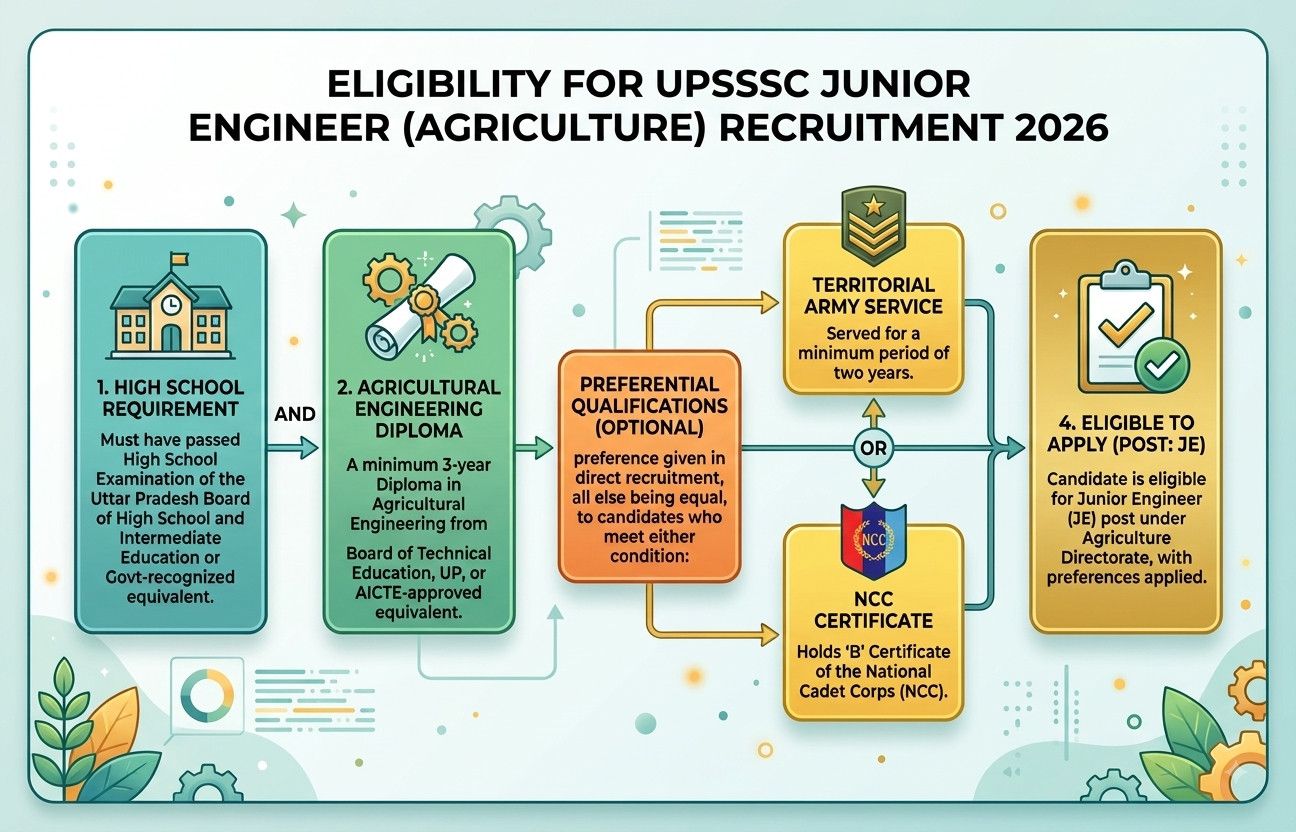
As per Rule 8, Part-4 of the Uttar Pradesh Agriculture Department Junior Engineer Service Rules, 2015, a candidate must possess the following qualifications for direct recruitment to the post of Junior Engineer:
(1) Must have passed the High School Examination of the Uttar Pradesh Board of High School and Intermediate Education or any examination recognized as equivalent by the Government.
(2) Must possess a three-year Diploma in Agricultural Engineering from the Board of Technical Education, Uttar Pradesh, or any equivalent qualification recognized by the Government and approved by AICTE (All India Council for Technical Education).
Preferential Qualification: As per Rule 9, Part-4 of the Uttar Pradesh Agriculture Department Junior Engineer Service Rules, 2015, preference shall be given in direct recruitment, all other things being equal, to candidates who:
(a) Have served in the Territorial Army for a minimum period of two years, or
(b) Have obtained the 'B' Certificate of the National Cadet Corps (NCC).
Age Limit
सरकारी नौकरी के लिए आयु सीमा का Special ध्यान रखा जाता है। नीचे दी गई टेबल में Junior Engineer (Agriculture) पद के लिए Minimum और Maximum Age बताई गई है, जिसकी Calculation 01 जुलाई 2026 के Basis पर की जाएगी।
Age Criteria
Age Limit
Minimum Age
18 Years (as of 01-07-2026)
Maximum Age
40 Years (as of 01-07-2026)
Age Relaxation
Reserved वर्ग के Candidates को Maximum आयु सीमा में सरकारी नियमों के अनुसार छूट प्रदान की जाती है।
Category
Age Relaxation
SC / ST Candidates of UP
As per UP Government rules
OBC Candidates of UP
Skilled Players of UP
Ex-Servicemen
Persons with Disabilities (PWD)
Application Fee And Process
Application Fee
UPSSSC ने Application फ़ार्म भरते समय सभी Categories के लिए एक समान Processing फीस रखी है। नीचे दी गई टेबल में आप अपनी Category के अनुसार लगने वाली फीस देख सकते हैं।
Category
Online Processing Fee
Unreserved (General)
Rs. 25/-
Other Backward Class (OBC)
Rs. 25/-
Scheduled Caste (SC)
Rs. 25/-
Scheduled Tribe (ST)
Rs. 25/-
Note: यह केवल Application Processing फीस है। Mains परीक्षा के लिए Shortlist होने वाले Candidates को Admit Card Download करने से पहले एक अलग Mains परीक्षा फीस जमा करनी होगी।
Application Process
UPSSSC Junior Engineer भर्ती के लिए Online Application फ़ार्म भरने की प्रक्रिया बहुत ही आसान है। नीचे दिए गए Steps को Follow करके आप अपना फ़ार्म भर सकते हैं:
Visit Official Website: सबसे पहले UPSSSC की Official Website (upsssc.gov.in) पर जाएं।
Find Official Notification: Homepage पर 'Live Advertisement' Section में जाएं और 19-Exam/2026 के Notification पर क्लिक करें।
PET Authentication: 'Apply' पर क्लिक करने के बाद आपको अपना PET-2025 Registration नंबर डालना होगा। आप OTP या अपनी Personal Details (Date of Birth, Gender, Domicile) से लॉग इन कर सकते हैं।
Fill Required Details: लॉग इन करने के बाद आपकी जानकारी अपने आप भर जाएगी। आपको केवल अपनी Academic Qualification (Agriculture Diploma) की Details भरनी होगी।
Photo And Signature: PET-2025 में अपलोड की गई फ़ोटो और Signature अपने आप स्क्रीन पर आ जाएंगे, इसमें कोई बदलाव नहीं किया जा सकता। बस 'Continue' पर क्लिक करें।
Other Details And Declaration: अपनी बाकी Details चेक करें, Declaration Box पर टिक करें और Captcha Code डालकर 'Save and Proceed' करें।
Pay Application Fee: अंत में 'Pay Fee' Option पर जाएं। आप Debit Card, Credit Card, Internet Banking, UPI या SBI e-Challan के जरिये 25 रुपये की फीस जमा कर सकते हैं।
Print Form: फीस जमा होने के बाद आपका फ़ार्म Final Submit हो जाएगा। अपने Application फ़ार्म का Print Out निकालकर भविष्य के लिए रख लें।
UPSSSC JE 2026 : Salary
Junior Engineer (Agriculture) एक बहुत ही Respected पद है और इसके लिए उत्तर प्रदेश सरकार द्वारा Attractive Salary दी जाती है। नीचे दी गई टेबल में इस पद के लिए Decided Pay Scale और Grade Pay कि Details है।
Salary Component
Details
Pay Level
Level - 6
Pay Band
Rs. 9,300 - Rs. 34,800/-
Grade Pay
Rs. 4,200/-
UPSSSC JE 2026 : Selection Process
UPSSSC Junior Engineer (Agriculture) भर्ती का Selection Process बहुत ही Transparent है जिसे नीचे समझाया गया है:
Step 1: Shortlisting based on PET-2025 Score: सबसे पहले उन सभी Candidates के Forms की जांच की जाएगी जिन्होंने Apply किया है। इसके बाद UPSSSC PET-2025 के Normalized स्कोर के आधार पर Candidates को Mains परीक्षा के लिए Shortlist किया जाएगा। आम तौर पर कुल Vacancy के 15 गुना Candidates को Mains परीक्षा देने का मौका मिलता है।
Step 2: Mains Written Examination: जो Candidates Shortlist होंगे, उन्हें Mains लिखित परीक्षा देनी होगी। इस परीक्षा में Agriculture Engineering, Computer Knowledge और UP General Knowledge से जुड़े प्रश्न पूछे जाएंगे। Final Merit List इसी परीक्षा में प्राप्त अंकों के Basis पर बनेगी।
Step 3: Document Verification (DV):लिखित परीक्षा पास करने वाले Candidates को Document Verification के लिए बुलाया जाएगा। यहाँ उनके अकादमिक Certificates, Category Certificates, और EWS/OBC Certificates (जो फ़ार्म भरने की अंतिम Date से पहले के हों) की जांच की जाएगी।
Step 4: Final Merit List: DV में सफल होने वाले Candidates की एक Final Merit List जारी की जाएगी, जिसके बाद उन्हें Agriculture Department में Posting दी जाएगी।
UPSSSC JE 2026 : Exam Pattern
परीक्षा की तैयारी सही दिशा में करने के लिए परीक्षा Pattern को समझना बहुत जरूरी है। नीचे दी गई टेबल में परीक्षा के Various भाग, प्रश्नों की संख्या, अंक और टाइम Duration Present किया गया है।
Part
Subject
Number of Questions
Total Marks
Time Period
Part-1
(1) Farm Power Engineering and Non-Conventional Sources of Energy
5
5
Two Hours (120 Minutes)
(2) I.C. Engine (Internal Combustion Engine)
5
5
(3) Tractor
5
5
(4) Non-Conventional Energy: Biogas Technology
5
5
(5) Wind Engineering Technology and Solar Energy Technology
5
5
(6) Post-Harvest Technology and Agro-Waste Industries: Introduction
5
5
(7) Agro-Based Industries
5
5
(8) Farm and Land Development Machinery: Farm Mechanization
5
5
(9) Irrigation and Drainage Engineering: Introduction
5
5
(10) Water Requirement of Plants
5
5
(11) Irrigation Methods and Minor Irrigation
5
5
(12) Soil and Water Conservation and Land Reclamation Engineering
5
5
(13) Land Reclamation and Ravine Reclamation
5
5
Part-2
Knowledge of concepts of Computer and Information Technology and contemporary technological development and innovation in this field
15
15
Part-3
General information related to the State of Uttar Pradesh
20
20
Total
100
100
Note: इस परीक्षा में Negative Marking का Provision रखा गया है। प्रत्येक गलत उत्तर के लिए 0.25 (यानी 1/4) अंक काटे जाएंगे।
Minimum Qualifying Marks
Qualification Type
Detail
Minimum Qualifying Marks
Selection and cut-off will be determined by UPSSSC based on candidates' performance in the Main Written Examination.
UPSSSC JE 2026 : Syllabus
परीक्षा का Syllabus बहुत ही Detailed है, जिसे तीन मुख्य भागों में बांटा गया है। नीचे दी गई टेबल में Syllabus के हर Important Topic को बताया गया है।
Subject Part
Detailed Topics
Part - 1: Subject Related Knowledge (Agriculture Engg)
1. Farm Power Engineering and Non-Conventional Sources of Energy
Introduction to farm power.
Sources of power on farms.
Comparative study, uses, and limitations of different power sources.
Animal power.
Fossil fuels (diesel and petrol).
Wind energy.
Solar energy.
Biogas energy.
Electric power.
2. I.C. Engines (Internal Combustion Engines)
Principles of heat engines.
Operating principles of I.C. engines.
Classification of I.C. engines.
Two-stroke and four-stroke engines.
Diesel and petrol engines.
Stationary, reciprocating, and rotary parts.
Materials of construction and functions of engine parts.
Terminology related to I.C. engines.
Numerical problems based on engine concepts.
Engine performance.
3. Tractor
Introduction to tractors.
Classification and adaptability of tractors.
Factors affecting tractor selection.
Overview of tractor makes, models, and horsepower ranges.
Operating costs of:
Small petrol engines
Diesel engines
Tractors
4. Non-Conventional Energy: Biogas Technology
Introduction to biogas.
Production of biogas.
Biodigestion of plant and animal waste.
Reactions during biodigestion.
Gases produced during biodigestion.
Removal of unwanted gases (CO₂ and H₂S).
Factors affecting biogas production.
Efficiency of biogas plants in winter.
Uses of biogas.
5. Wind Engineering and Solar Energy Technology
Types of windmills:
Vertical-axis windmills
Horizontal-axis windmills
Uses of windmills.
Site selection for windmill construction.
Operation and maintenance of windmills.
Solar radiation and solar energy potential in India.
Applications of solar energy.
Solar collectors.
6. Post-Harvest Technology and Agro-Waste Industries: Introduction
Importance of grain and seed processing.
Principles of agricultural processing.
Processing operations and sequence.
Flow diagrams in processing.
Services provided by processors to farmers.
Processing of:
Wheat
Maize
Paddy
Soybean
7. Agro-Based Industries
Sugarcane crushing.
Khandsari manufacturing.
Jaggery making processes and equipment.
Utilization of vegetable waste.
Utilization of animal waste.
Soybean by-products.
Potato by-products.
Dehydration of vegetables.
8. Farm and Land Development Machinery: Farm Mechanization
Definition of farm mechanization.
Status of farm mechanization in India.
Scope, limitations, and advantages of mechanization.
Primary and secondary tillage equipment.
Sowing and planting equipment.
Harvesting and threshing equipment.
Land development equipment.
Construction, operation, and output of:
Dozer
Scraper
Drag hoe
Dragline
9. Irrigation and Drainage Engineering: Introduction
Definition and history of irrigation.
Necessity and scope of irrigation.
Waterlogging and salinity:
Definitions
Need for control
Control measures
Relationship between irrigation and drainage.
Drainage efficiency.
Surface and subsurface drainage systems.
10. Water Requirements of Plants
Soil types.
Soil properties related to irrigation and drainage.
Classes and availability of soil water.
Evaporation, transpiration, and evapotranspiration.
Consumptive use of water.
Estimation of crop water requirements.
Duty of water and delta.
Assessment of irrigation requirements for different crops.
Estimation of irrigation depth and timing.
Irrigation scheduling based on soil-plant-atmosphere relationships.
11. Irrigation Methods and Minor Irrigation
Surface irrigation methods.
Subsurface irrigation methods.
Sprinkler irrigation systems.
Drip irrigation systems.
Conjunctive use of irrigation systems.
Measurement of irrigation efficiencies:
Water conveyance efficiency
Storage efficiency
Application efficiency
Distribution efficiency
Water use efficiency
Importance and necessity of minor irrigation.
Land surveying.
Methods of leveling.
Determination of cuts and fills.
Importance and necessity of land leveling.
Sources of minor irrigation.
Tubewells:
Definition
Need
Advantages and disadvantages
Characteristics of a tubewell site
Factors affecting site selection
12. Soil and Water Conservation and Land Reclamation Engineering
Mechanics, types, and causes of soil erosion.
Factors affecting erosion.
Damage caused by soil erosion.
Agronomic measures for soil and water conservation:
Contour farming
Mulching
Strip cropping
Cover cropping
Mixed cropping
Role of grasses in soil conservation.
Mechanical methods of erosion control:
Field bunding
Contour bunding
Graded bunding
Ridge and channel terraces
Gully erosion control.
Classification of gullies.
Temporary and permanent gully control structures:
Earthen check dams
Brush dams
Loose-rock dams
Straight-drop spillways
13. Land Reclamation and Ravine Reclamation
Classification of Usar soils.
Salt-tolerant crops.
Reclamation of Usar soils.
Reclamation of wastelands.
Reclamation of forest lands.
Reclamation of sandy soils.
Sand dune stabilization.
Classification of ravines.
Measures for ravine reclamation.
Part-2: Knowledge of Concepts of Computer and Information Technology and Contemporary Technological Development & Innovation
History, introduction, and applications of Computers.
Information Technology (IT).
Internet and World Wide Web (WWW).
General Knowledge Related to:
Computer Hardware and Software.
Input and Output Devices.
Internet Protocol (IP) Address.
IT Gadgets and their Applications.
Creation and operation/use of E-mail IDs.
Operation of Printers, Tablets, and Mobile Devices.
Important features of MS Word and MS Excel.
Operating Systems.
Social Networking.
E-Governance.
Other Topics:
Digital Financial Tools and Applications.
Future Skills and Cyber Security.
Technological Development and Innovation in the field of Computer and Information Technology, including:
Artificial Intelligence (AI)
Big Data Processing
Deep Learning
Machine Learning
Internet of Things (IoT)
India's achievements in the field of Information Technology and related innovations.
Part - 3: UP General Knowledge
History of Uttar Pradesh
Culture of Uttar Pradesh
Art and Architecture
Festivals and Fairs
Folk Dances
Literature
Regional Languages
Heritage and Historical Sites
Social Customs and Traditions
Tourism
Geographical Features and Environment
Natural Resources
Climate
Soil
Forests
Wildlife
Mines and Minerals
Economy
Agriculture
Industry
Business and Employment
Polity and Governance
Administration of Uttar Pradesh
Current Events related to Uttar Pradesh
Achievements of Uttar Pradesh in various fields
Result
Result से जुड़ी प्रक्रिया इस प्रकार होगी:
लिखित परीक्षा End होने के कुछ दिनों बाद Official Website पर Answer Key जारी की जाएगी, जिस पर Candidates Objection दर्ज कर सकेंगे।
Final Answer Key के आधार पर UPSSSC Result तैयार करेगा।
Result भी बोर्ड की Official Website पर ही अपलोड किया जाएगा, जहाँ Candidates अपना रोल नंबर या Registration नंबर डालकर अपना Status चेक कर सकते हैं।
जो Candidates Merit List में अपनी जगह बना लेंगे, उन्हें Document Verification के लिए बुलाया जाएगा और फिर Final Joining दी जाएगी।
Admit Card
लिखित परीक्षा से जुड़ी Admit Card की प्रक्रिया बहुत ही Important होती है। इसके बिना आपको परीक्षा हॉल में प्रवेश नहीं मिलेगा।
परीक्षा की Date के कुछ दिन पहले UPSSSC की Official Website पर Admit Card जारी कर दिए जाएंगे।
Note: केवल वही Candidates अपना Admit Card Download कर पाएंगे जो Mains परीक्षा के लिए Shortlist हुए हैं और जिन्होंने Mains परीक्षा फीस का भुगतान कर दिया है।
Admit Card Download करने के लिए आपको अपना Registration नंबर, Date of Birth और Gender डालकर Website पर लॉग इन करना होगा।
Admit Card में आपका नाम, परीक्षा Center, Reporting टाइम और परीक्षा के Rules लिखे होंगे।
Preparation Tips
यहाँ कुछ Preparation Tips दिए जा रहे हैं जो आपको UPSSSC Junior Engineer (Agriculture) भर्ती में Selection दिलाने में मदद करेंगे:
Syllabus को गहराई से समझें: सबसे पहले Official Syllabus का प्रिंट आउट निकाल लें। अपने Agriculture Engineering के डिप्लोमा नोट्स को अच्छे से Revise करें, क्योंकि Part-1 से 65% प्रश्न पूछे जाएंगे।
Computer और UP GK को Neglect न करें: अक्सर Candidates Technical विषय में लगे रहते हैं और Non-Tech छोड़ देते हैं। 35 अंक का Computer और UP GK आपके Selection का Basis बन सकता है। इसके लिए रोज कम से कम 1-2 घंटे का समय निकालें।
Time Management और Routine: अपनी टाइम टेबल फिक्स करें। हर विषय को उसके Weightage के According समय दें।
Previous Year Papers: UPSSSC द्वारा पहले करवाई गई JE परीक्षाओं के Paper Solve करें। इससे आपको परीक्षा के Level और Pattern का अंदाजा हो जाएगा।
Negative Marking से बचें: परीक्षा में 1/4th की Negative Marking है, इसलिए सिर्फ उन्हीं सवालों को Attempt करें जिन पर आप Confident हों।