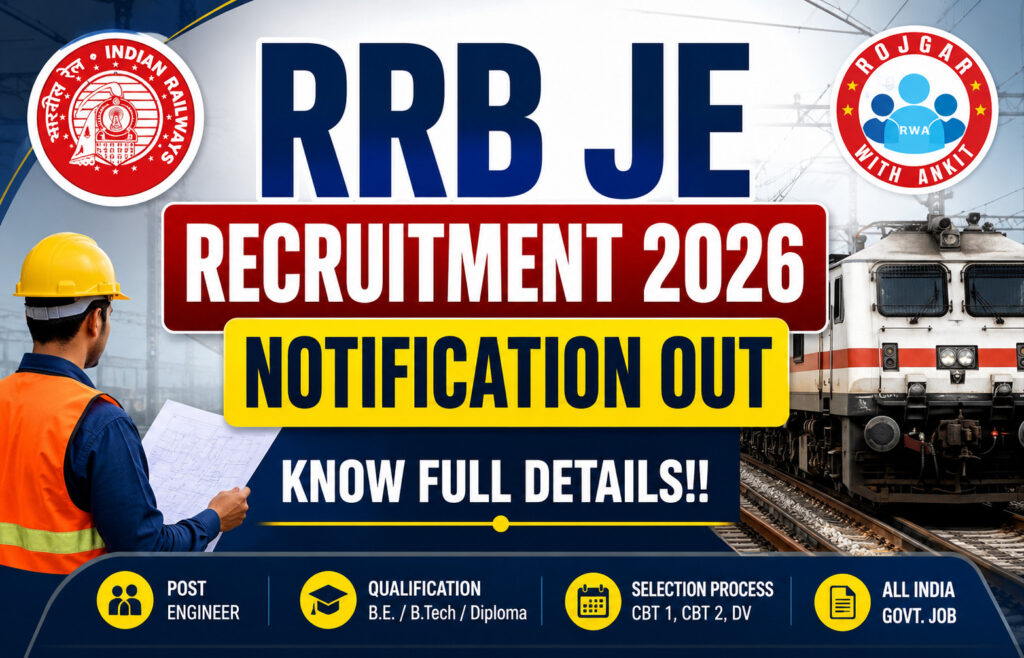
Railway RRB Junior Engineer (JE) Exam 2026 Notification Out
The Indian Railways, managed by the Ministry of Railways, Government of India, is one of the largest railway systems in the world. It provides transport services to millions of passengers and goods every day across the country. Every year, engineering graduates wait eagerly for the Railway Recruitment Board (RRB) Junior Engineer (JE) notification. This exam is a golden opportunity for those who want a stable, secure, and well-paid government job with many benefits and growth opportunities.
The RRB JE recruitment invites applications not only for Junior Engineer posts but also for positions such as Depot Material Superintendent (DMS) and Chemical & Metallurgical Assistant (CMA). Each of these roles plays an important part in keeping the Indian Railways running smoothly and efficiently. The RRB JE exam is known to be one of the most competitive exams in India, as it covers a wide syllabus and includes multiple stages of selection. Candidates go through different steps like two computer-based tests, document verification, and a medical fitness test before final selection.For the year 2026, the Indian Railways has announced 4029 vacancies across different zones of India.
Railway RRB Junior Engineer (JE): Overview Of The Exam
Field
Information
Organisation
Railway Recruitment Boards (RRBs)
Advt No.
CEN No. 04/2026
Post
Junior Engineer (JE) & Depot Material Superintendent (DMS)
Remembering important dates is the first step in your preparation. Missing a deadline might cause you to lose this opportunity.
Event
Date
Date of Indicative Notice in Employment News
25.07.2026
Opening Date of Online Application
14.08.2026
Closing Date for Online Application
13.09.2026 (23:59 Hours)
Last Date for Fee Payment
15.09.2026
Application Modification Window
16.09.2026 to 25.09.2026
Scribe Details Submission Window
26.09.2026 to 30.09.2026
All candidates must submit their applications online on the official regional RRB websites. Applications or payments sent after the deadline will not be accepted under any condition.
Railway RRB Junior Engineer (JE): Vacancy Details
This year, the RRB JE exam will be conducted for 2585 vacancies of Junior Engineer, Depot Material Superintendent, Chemical Supervisor & Metallurgical Assistant. The category-wise vacancy details will be released along with the detailed notification.
RRB Zone
UR
SC
ST
OBC
EWS
Total
Ahmedabad
45
24
19
38
17
143
Ajmer
110
41
10
68
23
252
Bengaluru
119
45
23
79
32
298
Bhopal
58
17
10
27
8
120
Bhubaneswar
40
14
4
19
9
86
Bilaspur
51
19
19
22
13
124
Chandigarh
77
31
13
49
13
183
Chennai
152
62
36
83
44
377
Gorakhpur
67
44
22
40
25
198
Guwahati
132
54
29
87
31
333
Jammu-Srinagar
86
16
12
27
11
152
Kolkata
195
58
51
101
52
457
Malda
9
8
3
7
3
30
Mumbai
175
67
36
96
37
411
Muzaffarpur
7
4
2
3
1
17
Patna
29
20
11
15
5
80
Prayagraj
164
49
33
67
28
341
Ranchi
49
21
8
31
13
122
Secunderabad
68
15
6
12
9
110
Siliguri
35
12
7
26
12
92
Thiruvananthapuram
45
11
12
22
11
101
Overall Total
1,714
633
366
919
398
4029
For details related to how vacancies are divided according to region, category, and branch, candidates should check the official Centralized Employment Notification (CEN) on the RRB website of their region.
Railway RRB Junior Engineer (JE):Eligibility
Before applying, it is important to confirm that you meet the eligibility requirements for the post.
Educational Qualification
Post
Educational Qualification
Junior Engineer
Diploma/Degree in (Electrical, Mechanical, Engineering, S&T) Engineering or Relevant Stream from a recognised university.
Depot Material Superintendent
Diploma/Degree in Engineering from any discipline
Chemical Supervisor & Metallurgical Supervisor
Bachelor's degree in Science with Physics and Chemistry with minimum 55% marks
Age Limit
Minimum Age: 18 years
Maximum Age: 33 years (as on 01.01.2026)
Age relaxation will be given to candidates belonging to reserved categories such as SC/ST/OBC, Ex-servicemen, and others as per government rules. Candidates should check the official notification for complete details.
Railway RRB Junior Engineer (JE): Application Fee
The application fee varies according to category:
Category
Fee
Refund
Gen / OBC / EWS
₹ 500/-
₹ 400/-
SC / ST / EBC / Female / Transgender
₹ 250/-
₹ 250/-
Refunds will be given after participating in the Computer-Based Test (CBT-1):
General category: ₹400 will be refunded.
SC/ST/EWS/OBC/PwBD/Female/Transgender/Ex-servicemen: Full ₹250 will be refunded.
Railway RRB Junior Engineer (JE): Application Process
Applications must be submitted online only through the official RRB regional website.
Aadhaar details are verified during registration, so ensure your name, date of birth, and details match your Aadhaar and 10th certificate.
Upload a clear, recent photo and scan of your signature.
Review your information carefully before submitting.
Save or print your application form and payment receipt to keep for future use or verification.
Railway RRB Junior Engineer (JE): Salary
The salary for RRB JE, DMS, and CMA posts follows the 7th Central Pay Commission (CPC) recommendations.
Post
Pay Level in 7th CPC
Initial Pay
Junior Engineer, Depot Material Supreintendent and Chemical & Metallurgical Assistant
Level 6
35,400
In addition, employees receive many benefits like:
Dearness Allowance (DA)
House Rent Allowance (HRA)
Transport Allowance
Pension and Medical facilities
This structure makes these jobs not just financially stable but also highly respected and rewarding.
Railway RRB Junior Engineer (JE): Selection Process
The RRB JE selection process is based purely on merit and includes the following steps:
First Stage Computer-Based Test (CBT-1)
Second Stage Computer-Based Test (CBT-2)
Document Verification
Medical Examination
Candidates need to qualify in each stage to reach the next one. After clearing both exams, documents are checked, and finally, a medical test ensures candidates meet the required health standards before being appointed.
Railway RRB Junior Engineer (JE): Exam Pattern
CBT 1 Exam Pattern
This is the first screening test that all applicants must take.
Total Questions: 100 Multiple Choice Questions
Duration: 90 minutes
Marking Scheme: +1 for each correct answer, -⅓ for each wrong answer
Subjects
No. of Questions
Marks
Time
Maths
30
30
90 Minutes
General Intelligence & Reasoning
25
25
General Awareness
15
15
General Science
30
30
Total
100
100
Minimum Qualifying Percentage:
UR – 40%
OBC – 30%
SC – 30%
ST – 25%
(PwBD candidates get 2% relaxation.)
CBT 2 Exam Pattern
Candidates who clear CBT-1 proceed to CBT-2, which tests deeper knowledge.
Total Questions: 150 MCQs
Duration: 120 minutes
Marking Scheme: +1 for each correct, -⅓ for each wrong answer
Subjects
No. Of Questions
Marks
Times
General Awareness
15
15
120 Minutes
Physics and Chemistry
15
15
Basics of Computer and Application
10
10
Basics of Environment and Pollution Control
10
10
Technical Abilities
100
100
Total
150
150
The technical part changes according to your engineering branch (Civil, Mechanical, Electrical, Computer Science, etc.).
RRB JE Recruitment 2026: Syllabus
Syllabus for CBT I
Mathematics
Number System: Includes questions on number types, operations (using the BODMAS rule), integers, rational and irrational numbers, and real numbers.
Fractions and Decimals: Operations involving fractions and converting between fractions and decimals.
HCF and LCM: Finding the highest common factor and least common multiple.
Commercial Mathematics:
Ratio and Proportion: Covers basic ratios and direct and inverse proportions.
Percentage: Calculation of percentages and problems involving percentage increase or decrease.
Time and Work: Efficiency-based problems and questions involving pipes and cisterns.
Time, Speed, and Distance: Covers average speed, relative speed, and problems on trains and boats.
Profit and Loss: Includes topics like discounts, cost price, and selling price.
Simple and Compound Interest: Calculations and differences between simple and compound interest.
Algebra: Linear and quadratic equations, and basic algebraic expressions.
Geometry: Basic theorems related to triangles, circles, and quadrilaterals.
Trigonometry: Basic trigonometric ratios and identities.
Mensuration: Formulas for the area and perimeter of 2D shapes, and the surface area and volume of 3D shapes.
Statistics: Questions related to elementary statistics such as mean, median, mode, and data interpretation (including bar diagrams, pie charts, and histograms).
Miscellaneous: Problems based on age calculations, calendars and clocks, and investments.
General Intelligence and Reasoning
Verbal Reasoning:
Analogies: Word-based, number-based, and figure-based analogies.
Alphabetical and Number Series: Identifying patterns in alphabetical and number sequences.
Coding and Decoding: Questions involving coded language or numerical codes.
Classification: Grouping objects, numbers, or words based on a common property.
Syllogism: Drawing conclusions from given statements.
Statement and Arguments/Assumptions: Analyzing statements and evaluating the strength of arguments or underlying assumptions.
Non-Verbal Reasoning:
Venn Diagrams: Interpreting relationships using Venn diagrams.
Counting of Figures: Determining the number of a specific geometric shape in a figure.
Embedded Figures: Identifying a hidden figure within a complex pattern.
Paper Cutting and Folding: Predicting the outcome of paper folding and cutting.
Other Topics:
Mathematical Operations: Problems based on the mathematical signs and numbers.
Relationships: Blood relations and other forms of logical relationships.
Jumbling: Rearranging jumbled sentences or letters.
Data Interpretation and Sufficiency: Assessing whether the given data is sufficient to answer a question.
Directions: Problems based on direction and distance.
General Awareness
Current Affairs: Awareness of recent national and international events, awards and honors, and government schemes.
History: Covers ancient, medieval, and modern Indian history, including the freedom struggle.
Geography: Questions related to the physical, social, and economic geography of India and the world.
Polity: The Constitution of India, the political system, and governance.
Indian Economy: Basic economic concepts, national income, budget, and economic reforms.
Science and Technology: Recent scientific developments, inventions, and discoveries, as well as basic computer knowledge.
Culture: Indian art, dance, music, festivals, and cultural heritage.
Sports: Major national and international sporting events and sports personalities.
Environmental Issues: Awareness of environmental challenges, including pollution, global warming, and climate change.
Miscellaneous: Questions on famous personalities, books and authors, and important national and international days.
Syllabus for CBT 2
Engineering Mechanics
Force (resolution of force, moment of force, force system, composition of
forces), Equilibrium, Friction, Centroid and Center of gravity, Simple machines.
Basic concepts
Concepts of resistance, inductance, capacitance, and various factors affecting them. Concepts of current, voltage, power, energy and their units.
Basics of Computers and Applications
Computers and their architecture , MS Office , Storage devices , Operating Systems , Internet and Email , Websites & Web Browsers Networking , Computer Virus.
Basics of Environment and Pollution Control
Basics of Environment , The adverse effect of environmental pollutionPollution control strategies , Waste Management ,Acid rain , Ozone depletion
Engineering Mechanics
Resolution of forces, Equilibrium and Equilibrant, parallelogram law of forces, triangle law of forces, polygon law of forces and Lami’s theorem, couple and moment of a couple, condition for equilibrium of rigid body subjected to number of coplanar non-concurrent forces, definition of static friction, dynamic friction, derivation of limiting angle of friction and angle of repose, resolution of forces considering friction
Railway RRB Junior Engineer (JE): Result
RRB will declare the results for each CBT stage separately on its regional websites.
Results are released in PDF format with the roll numbers or names of selected candidates.
Candidates who clear both CBTs will be invited for document verification and medical examination.
Final merit lists will be prepared after successful completion of all stages.
Always check your regional RRB website regularly for any updates, announcements, or selection lists.
Railway RRB Junior Engineer (JE): Admit Card
Admit cards will be available online on the respective RRB websites around 10 days before the exam.
To download, use your registration number and password.
Check all details such as your name, roll number, exam date, and center carefully.
Print more than one copy and carry a valid photo ID (like Aadhaar, PAN, or Driving License) to the examination hall.
Note: Admit cards will not be sent by post; they must be downloaded from the official portal only.
Preparation Tips
Preparing for the RRB JE exam needs both dedication and smart planning. Follow these easy and effective tips:
Understand the syllabus and pattern first: This helps you know what to study and how to plan your time.
Make a daily study timetable:Divide your subjects and revise them regularly.
Build strong basics:Before going deep into complex topics, be clear with the fundamental concepts of mathematics and science.
Practice reasoning and aptitude daily:This improves your speed and accuracy.
Stay updated on current affairs: Read news, current events, and railway-related information.
Solve previous year question papers:Understand question trends and difficulty levels.
Take mock tests: Practice online mock exams to get used to the real exam environment and improve time management.
Revise regularly:Especially for technical subjects; make short notes for quick revision.
Manage time during the exam: Don’t get stuck on one question; move ahead if unsure.
Maintain your health:Enough rest, good food, and a stress-free mind can help you perform better.

 Some Important Link :