
Question 1:
Directions: In the following questions one/some statements are given, followed by two conclusions I and II. You have to consider whether the statement is true, even if it seems to be at variance with commonly known facts. You have to decide which of the given conclusions can definitely be drawn from the given statements?
निर्देश: निम्न प्रश्नों में एक / कुछ कथन दिए गए है, जिनके आगे दो निष्कर्ष I और II निकाले गए हैं। आपकों विचार करना है कि कथन सत्य है, चाहे वह सामान्यतः ज्ञात तथ्यों से भिन्न प्रतीत होता हो। आपको निर्णय करना है कि दिए गए कथन में से कौन-सा निष्कर्ष निश्चित रूप से सही निकल सकता है?
उत्तर दीजिए-
(A) Only conclusion I is implicit
(A) केवल निष्कर्ष I ही निहित है
(B) Only conclusion II is implicit
(B) केवल निष्कर्ष II ही निहित है
(C) Both conclusion I and II are implicit
(C) निष्कर्ष I और II दोनों निहित हैं
(D) Neither conclusion I nor conclusion II is implicit
(D) न तो निष्कर्ष I और न ही निष्कर्ष II निहित है
Statement: Time and flow wait for no one.
कथन: समय और प्रवाह किसी का इंतजार नहीं करता ।
Conclusion / निष्कर्ष : I. समय किसी के नियंत्रण में नहीं है। / Time is not in anyone's control.
II. हर किसी को अतीत के बुरे अनुभवों को भूलकर जीवन में आगे बढ़ना चाहिए। / Everyone should forget the bad experiences of the past and move forward in life.
Question 2:
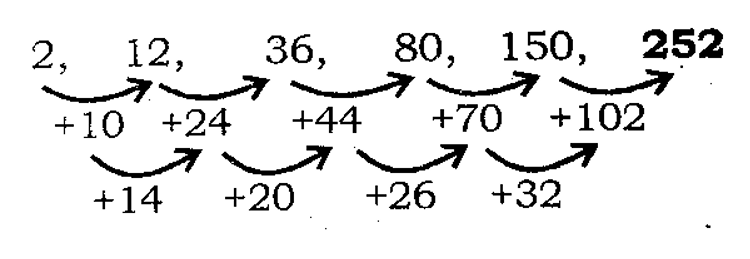
2, 12, 36, 80, 150, ?
Question 3:
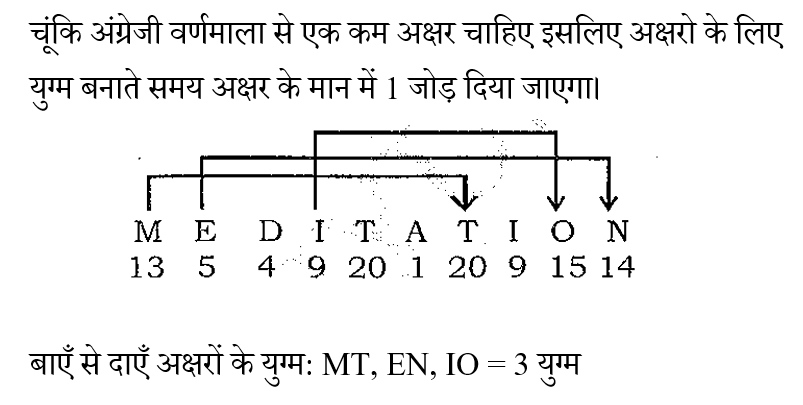
How many such letter pairs are there in the word 'MEDITATION' each of which has one less letter between them than the other in the English alphabetical order?
शब्द 'MEDITATION' में ऐसे कितने अक्षर युग्म है जिनके बीच में अंग्रेजी वर्णमाला क्रम से एक कम अक्षर आते है?
Question 4:
Which of the following days cannot be the first day of a century?
इनमें से कौन सा दिन किसी शताब्दी का प्रथम दिन नही हो सकता?
Question 5:
कथन: R≥U=P; S≥T=M; P>Y<W
निष्कर्ष:
I. U>Y
II. R> P
III. R=P
Question 6:
Thus only conclusion I and either II or III follows. Arrange the following words as per dictionary order.
इस प्रकार केवल निष्कर्ष I और या तो II या III अनुसरण करता है। शब्दकोश क्रम के अनुसार निम्नलिखित शब्दों को व्यवस्थित करें।
(1) Cinnabar
(2) Cinder
(3) Cinema
(4) Cinnamon
(5) Cinchona
Question 7: 
Question 8:
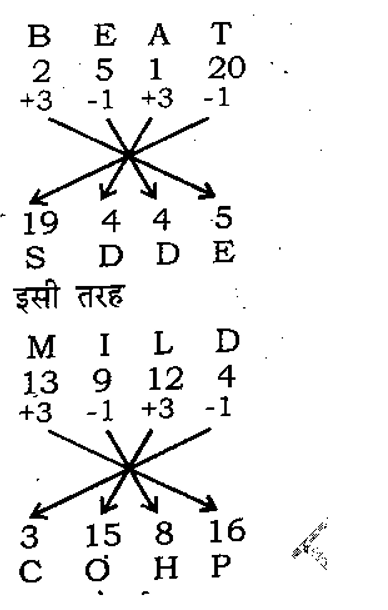
In a certain code language BEAT is written as SDDE. How will MILD be written in the same code language?
किसी निश्चित सांकेतिक भाषा में BEAT को SDDE लिखा जाता है। उसी सांकेतिक भाषा में MILD को कैसे लिखा जाएगा?
Question 9:
Directions: In each of the following, four/five options are given out of which three/four are alike in some manner while the remaining one is different. Choose the option which is different from the rest.
निर्देश: निम्नलिखित में से प्रत्येक में, चार/पांच विकल्प दिए गए है, जिनमें से तीन / चार किसी न किसी रूप में समान है, जबकि शेष एक अलग है। वह विकल्प चुने जो बाकी से अलग हो ।
Question 10:
Directions: Find the related word from the options given below.
निर्देश: नीचे दिए गए विकल्पों में से संबंधित शब्द ज्ञात कीजिए।
Thread : Cloth :: Wire : ? / धागा : कपड़ा :: तार : ?