
Question 1:
निर्देश : निम्नलिखित जानकारी का ध्यानपूर्वक अध्ययन करें और नीचे दिए गए प्रश्नों के उत्तर दें।
Direction : Study the following information carefully and answer the questions given below.
एक निश्चित कोड भाषा में,
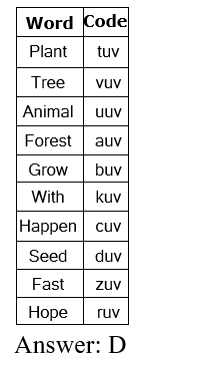
“plant tree animal forest” को “vuv uuv auv tuv” के रूप में लिखा जाता है
“grow with tree happen” को “kuv buv vuv cuv” के रूप में लिखा जाता है
“seed grow fast forest” को “duv buv zuv auv” के रूप में लिखा जाता है
“animal happen seed hope” को “ruv uuv cuv duv” के रूप में लिखा जाता है
In a certain code language,
“plant tree animal forest” is written as “vuv uuv auv tuv”
“grow with tree happen” is written as “kuv buv vuv cuv”
“seed grow fast forest” is written as “duv buv zuv auv”
“animal happen seed hope” is written as “ruv uuv cuv duv”
What is the code for the phrase “plant hope happen” in the given code language?
दी गई कोड भाषा में वाक्यांश “plant hope happen” के लिए कोड क्या है?
Question 2:
निर्देश : निम्नलिखित जानकारी का ध्यानपूर्वक अध्ययन करें और नीचे दिए गए प्रश्नों के उत्तर दें।
Direction : Study the following information carefully and answer the questions given below.
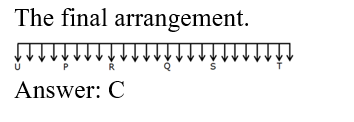
एक निश्चित संख्या में व्यक्ति दक्षिण की ओर मुख करके एक रैखिक पंक्ति में बैठे हैं। R और Q के मध्य केवल चार व्यक्ति बैठे हैं। Q, S के दायें से चौथे स्थान पर बैठा है। R और S के बीच बैठे व्यक्तियों की संख्या, S और T के बीच बैठे व्यक्तियों की संख्या से तीन अधिक है, जो किसी एक छोर से दूसरे स्थान पर बैठा है। P, Q के दायें से नौवें स्थान पर और R और U के ठीक बीच में बैठा है, जो किसी एक अंतिम छोर पर बैठा है।
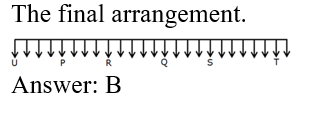
A certain number of persons are sitting in a linear row facing towards south. Only four persons are sitting between R and Q. Q sits fourth to the right of S. The number of persons sitting between R and S is three more than the number of persons sitting between S and T, who sits second from one of the ends. P sits ninth to the right of Q and exactly between R and U, who sits at one of the extreme ends.
How many persons are sitting in the row?
पंक्ति में कितने व्यक्ति बैठे हैं?
Question 3:
निर्देश : निम्नलिखित जानकारी का ध्यानपूर्वक अध्ययन करें और नीचे दिए गए प्रश्नों के उत्तर दें।
Direction : Study the following information carefully and answer the questions given below.
एक निश्चित संख्या में व्यक्ति दक्षिण की ओर मुख करके एक रैखिक पंक्ति में बैठे हैं। R और Q के मध्य केवल चार व्यक्ति बैठे हैं। Q, S के दायें से चौथे स्थान पर बैठा है। R और S के बीच बैठे व्यक्तियों की संख्या, S और T के बीच बैठे व्यक्तियों की संख्या से तीन अधिक है, जो किसी एक छोर से दूसरे स्थान पर बैठा है। P, Q के दायें से नौवें स्थान पर और R और U के ठीक बीच में बैठा है, जो किसी एक अंतिम छोर पर बैठा है।
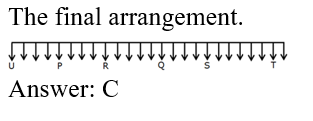
A certain number of persons are sitting in a linear row facing towards south. Only four persons are sitting between R and Q. Q sits fourth to the right of S. The number of persons sitting between R and S is three more than the number of persons sitting between S and T, who sits second from one of the ends. P sits ninth to the right of Q and exactly between R and U, who sits at one of the extreme ends.
Who among the following person sits exactly between T and Q?
निम्नलिखित में से कौन सा व्यक्ति T और Q के ठीक बीच में बैठा है?
Question 4:
निर्देश : निम्नलिखित जानकारी का ध्यानपूर्वक अध्ययन करें और नीचे दिए गए प्रश्नों के उत्तर दें।
Direction : Study the following information carefully and answer the questions given below.
एक निश्चित संख्या में व्यक्ति दक्षिण की ओर मुख करके एक रैखिक पंक्ति में बैठे हैं। R और Q के मध्य केवल चार व्यक्ति बैठे हैं। Q, S के दायें से चौथे स्थान पर बैठा है। R और S के बीच बैठे व्यक्तियों की संख्या, S और T के बीच बैठे व्यक्तियों की संख्या से तीन अधिक है, जो किसी एक छोर से दूसरे स्थान पर बैठा है। P, Q के दायें से नौवें स्थान पर और R और U के ठीक बीच में बैठा है, जो किसी एक अंतिम छोर पर बैठा है।
A certain number of persons are sitting in a linear row facing towards south. Only four persons are sitting between R and Q. Q sits fourth to the right of S. The number of persons sitting between R and S is three more than the number of persons sitting between S and T, who sits second from one of the ends. P sits ninth to the right of Q and exactly between R and U, who sits at one of the extreme ends.
Four of the following five are alike in a certain way as per the given arrangement and hence form a group. Find the one who doesn’t belong to that group.
दी गई व्यवस्था के अनुसार निम्नलिखित पांच में से चार एक निश्चित तरीके से समान हैं और इसलिए एक समूह बनाते हैं। उस एक को खोजें जो उस समूह से संबंधित नहीं है।

Question 5:
निर्देश : निम्नलिखित जानकारी का ध्यानपूर्वक अध्ययन करें और नीचे दिए गए प्रश्नों के उत्तर दें।
Direction : Study the following information carefully and answer the questions given below.
एक निश्चित संख्या में व्यक्ति दक्षिण की ओर मुख करके एक रैखिक पंक्ति में बैठे हैं। R और Q के मध्य केवल चार व्यक्ति बैठे हैं। Q, S के दायें से चौथे स्थान पर बैठा है। R और S के बीच बैठे व्यक्तियों की संख्या, S और T के बीच बैठे व्यक्तियों की संख्या से तीन अधिक है, जो किसी एक छोर से दूसरे स्थान पर बैठा है। P, Q के दायें से नौवें स्थान पर और R और U के ठीक बीच में बैठा है, जो किसी एक अंतिम छोर पर बैठा है।
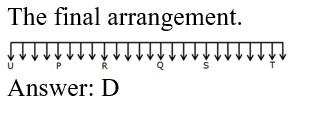
A certain number of persons are sitting in a linear row facing towards south. Only four persons are sitting between R and Q. Q sits fourth to the right of S. The number of persons sitting between R and S is three more than the number of persons sitting between S and T, who sits second from one of the ends. P sits ninth to the right of Q and exactly between R and U, who sits at one of the extreme ends.
How many persons sit between U and S?
U और S के मध्य कितने व्यक्ति बैठे हैं?
Question 6:
निर्देश : निम्नलिखित जानकारी का ध्यानपूर्वक अध्ययन करें और नीचे दिए गए प्रश्नों के उत्तर दें।
Direction : Study the following information carefully and answer the questions given below.
एक निश्चित संख्या में व्यक्ति दक्षिण की ओर मुख करके एक रैखिक पंक्ति में बैठे हैं। R और Q के मध्य केवल चार व्यक्ति बैठे हैं। Q, S के दायें से चौथे स्थान पर बैठा है। R और S के बीच बैठे व्यक्तियों की संख्या, S और T के बीच बैठे व्यक्तियों की संख्या से तीन अधिक है, जो किसी एक छोर से दूसरे स्थान पर बैठा है। P, Q के दायें से नौवें स्थान पर और R और U के ठीक बीच में बैठा है, जो किसी एक अंतिम छोर पर बैठा है।
A certain number of persons are sitting in a linear row facing towards south. Only four persons are sitting between R and Q. Q sits fourth to the right of S. The number of persons sitting between R and S is three more than the number of persons sitting between S and T, who sits second from one of the ends. P sits ninth to the right of Q and exactly between R and U, who sits at one of the extreme ends.
If W sits third to the right of R, then what is the position of W with respect to T?
यदि W, R के दायें से तीसरे स्थान पर बैठा है, तो T के सन्दर्भ में W का स्थान क्या है?
Question 7:
In each question, the relationship between different elements is shown in the statements followed by two conclusions. Find the conclusion which is definitely true.
प्रत्येक प्रश्न में, विभिन्न तत्वों के बीच संबंध को कथनों के बाद दिए गए दो निष्कर्षों में दिखाया गया है। वह निष्कर्ष ज्ञात कीजिए जो निश्चित रूप से सत्य है।
कथन: H = P > L ≥ V < U < T ≥ I
Statement: H = P > L ≥ V < U < T ≥ I
निष्कर्ष: I) T > L II) P ≥ V
Conclusions: I) T > L II) P ≥ V
Question 8:
In each question, the relationship between different elements is shown in the statements followed by two conclusions. Find the conclusion which is definitely true.
प्रत्येक प्रश्न में, विभिन्न तत्वों के बीच संबंध को कथनों के बाद दिए गए दो निष्कर्षों में दिखाया गया है। वह निष्कर्ष ज्ञात कीजिए जो निश्चित रूप से सत्य है।
कथन: A ≥ C = B ≤ D > E > F < G
Statement: A ≥ C = B ≤ D > E > F < G
निष्कर्ष: I) D > C II) D = C
Conclusions: I) D > C II) D = C
Question 9:
In each question, the relationship between different elements is shown in the statements followed by two conclusions. Find the conclusion which is definitely true. प्रत्येक प्रश्न में, विभिन्न तत्वों के बीच संबंध को कथनों के बाद दिए गए दो निष्कर्षों में दिखाया गया है। वह निष्कर्ष ज्ञात कीजिए जो निश्चित रूप से सत्य है।
कथन: P > Q < R = S; T ≥ R < U ≤ V
Statements: P > Q < R = S; T ≥ R < U ≤ V
निष्कर्ष: I) V > Q II) T ≥ S
Conclusions: I) V > Q II) T ≥ S
Question 10:
In each question, the relationship between different elements is shown in the statements followed by two conclusions. Find the conclusion which is definitely true.
प्रत्येक प्रश्न में, विभिन्न तत्वों के बीच संबंध को कथनों के बाद दिए गए दो निष्कर्षों में दिखाया गया है। वह निष्कर्ष ज्ञात कीजिए जो निश्चित रूप से सत्य है।
कथन: L < M ≤ N ≥ O; P = N > Q ≥ R
Statements: L < M ≤ N ≥ O; P = N > Q ≥ R
निष्कर्ष: I) P ≥ L II) N > R
Conclusions: I) P ≥ L II) N > R