
Question 1:
निर्देश : निम्नलिखित जानकारी का ध्यानपूर्वक अध्ययन करें और नीचे दिए गए प्रश्नों के उत्तर दें।
Direction : Study the following information carefully and answer the questions given below.
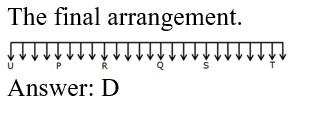
एक निश्चित संख्या में व्यक्ति दक्षिण की ओर मुख करके एक रैखिक पंक्ति में बैठे हैं। R और Q के मध्य केवल चार व्यक्ति बैठे हैं। Q, S के दायें से चौथे स्थान पर बैठा है। R और S के बीच बैठे व्यक्तियों की संख्या, S और T के बीच बैठे व्यक्तियों की संख्या से तीन अधिक है, जो किसी एक छोर से दूसरे स्थान पर बैठा है। P, Q के दायें से नौवें स्थान पर और R और U के ठीक बीच में बैठा है, जो किसी एक अंतिम छोर पर बैठा है।
A certain number of persons are sitting in a linear row facing towards south. Only four persons are sitting between R and Q. Q sits fourth to the right of S. The number of persons sitting between R and S is three more than the number of persons sitting between S and T, who sits second from one of the ends. P sits ninth to the right of Q and exactly between R and U, who sits at one of the extreme ends.
How many persons sit between U and S?
U और S के मध्य कितने व्यक्ति बैठे हैं?
Question 2:
निर्देश : निम्नलिखित जानकारी का ध्यानपूर्वक अध्ययन करें और नीचे दिए गए प्रश्नों के उत्तर दें।
Direction : Study the following information carefully and answer the questions given below.
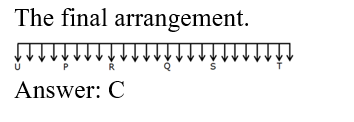
एक निश्चित संख्या में व्यक्ति दक्षिण की ओर मुख करके एक रैखिक पंक्ति में बैठे हैं। R और Q के मध्य केवल चार व्यक्ति बैठे हैं। Q, S के दायें से चौथे स्थान पर बैठा है। R और S के बीच बैठे व्यक्तियों की संख्या, S और T के बीच बैठे व्यक्तियों की संख्या से तीन अधिक है, जो किसी एक छोर से दूसरे स्थान पर बैठा है। P, Q के दायें से नौवें स्थान पर और R और U के ठीक बीच में बैठा है, जो किसी एक अंतिम छोर पर बैठा है।
A certain number of persons are sitting in a linear row facing towards south. Only four persons are sitting between R and Q. Q sits fourth to the right of S. The number of persons sitting between R and S is three more than the number of persons sitting between S and T, who sits second from one of the ends. P sits ninth to the right of Q and exactly between R and U, who sits at one of the extreme ends.
If W sits third to the right of R, then what is the position of W with respect to T?
यदि W, R के दायें से तीसरे स्थान पर बैठा है, तो T के सन्दर्भ में W का स्थान क्या है?
Question 3:
In each question, the relationship between different elements is shown in the statements followed by two conclusions. Find the conclusion which is definitely true.
प्रत्येक प्रश्न में, विभिन्न तत्वों के बीच संबंध को कथनों के बाद दिए गए दो निष्कर्षों में दिखाया गया है। वह निष्कर्ष ज्ञात कीजिए जो निश्चित रूप से सत्य है।
कथन: H = P > L ≥ V < U < T ≥ I
Statement: H = P > L ≥ V < U < T ≥ I
निष्कर्ष: I) T > L II) P ≥ V
Conclusions: I) T > L II) P ≥ V
Question 4:
In each question, the relationship between different elements is shown in the statements followed by two conclusions. Find the conclusion which is definitely true.
प्रत्येक प्रश्न में, विभिन्न तत्वों के बीच संबंध को कथनों के बाद दिए गए दो निष्कर्षों में दिखाया गया है। वह निष्कर्ष ज्ञात कीजिए जो निश्चित रूप से सत्य है।
कथन: A ≥ C = B ≤ D > E > F < G
Statement: A ≥ C = B ≤ D > E > F < G
निष्कर्ष: I) D > C II) D = C
Conclusions: I) D > C II) D = C
Question 5: 
Question 6: 
Question 7:
Pipe A can fill the tank in 40 hours and ratio of the efficiency of pipe A to B is 3:2. Pipe B and pipe C together can fill the tank in 30 hours. In how many hours, pipe A, B and pipe C together can fill the tank?
पाइप A टैंक को 40 घंटे में भर सकता है और पाइप A से B की दक्षता का अनुपात 3:2 है। एकसाथ पाइप B और पाइप C टैंक को 30 घंटे में भर सकते हैं। एकसाथ पाइप A, B और पाइप C कितने घंटे में टैंक को भर सकते हैं?
Question 8:
A train crosses an electric pole in 18 seconds and the train crosses 250 m long tunnel in 36 seconds. What is the speed of the train?
एक ट्रेन 18 सेकंड में बिजली के खंभे को पार करती है और ट्रेन 36 सेकंड में 250 मीटर लंबी सुरंग को पार करती है। ट्रेन की गति क्या है?
Question 9:
A boat can travel 90 km upstream and 120 km downstream in 12 hours 30 minutes. What is the speed of the stream, if the boat can travel 60 km downstream in 2 hours 30 minutes?
एक नाव धारा के प्रतिकूल 90 किमी और धारा के अनुकूल 120 किमी की यात्रा 12 घंटे 30 मिनट में कर सकती है। धारा की गति क्या है, यदि नाव धारा के अनुकूल 60 किमी की यात्रा 2 घंटे 30 मिनट में कर सकती है?
Question 10:
Difference between the simple interest and compound interest on the same sum for 2 years at the rate of 15% per annum is Rs.123.75. Find the sum?
15% प्रति वर्ष की दर से 2 वर्ष के लिए समान राशि पर साधारण ब्याज और चक्रवृद्धि ब्याज के बीच का अंतर 123.75 रुपये है। राशि ज्ञात कीजिए?