BIHAR SSC (30 June 2024)

Question 1:

Which of the following is incorrectly matched?

निम्नलिखित में से कौन सा गलत मिलान है?

  • दाब - पास्कल Pressure - Pascal

  • बल - न्यूटन Force - Newton

  • किया गया कार्य- जूल Work done - Joule

  • आयतन - मीटर Volume - Metre

Question 2:

Which of the following statements is not correct regarding Rutherford’s atomic model?

रदरफोर्ड के परमाणु मॉडल के संदर्भ में निम्नलिखित में से कौन सा कथन सही नहीं है?

  • एक परमाणु का लगभग संपूर्ण द्रव्यमान नाभिक में होता है । Almost the entire mass of an atom is in the nucleus.

  • इलेक्ट्रॉन नाभिक के चारों ओर वृत्ताकार मार्ग में चक्कर लगाते हैं। Electrons revolve around the nucleus in a circular path.

  • नाभिक का आकार परमाणु के आकार की तुलना में काफ़ी ज़्यादा होता है। The size of the nucleus is much larger than the size of the atom.

  • परमाणु का केंद्र धनावेशित होता है जिसे नाभिक कहा जाता है। The centre of the atom is positively charged and is called the nucleus.

Question 3:

Which of the following are metalloids?

निम्नलिखित में से कौन-से उपधातु हैं?

  • ऐलुमिनियम, मर्करी, कॉपर aluminium, mercury, copper

  • बोरान, सिलिकॉन, ऐन्टिमनी Boron, silicon, antimony

  • बोरॉन, मर्करी, आयरन Boron, mercury, iron

  • बोरॉन, ऑक्सीजन, ऐलुमीनियम Boron, oxygen, aluminium

Question 4:

The reaction between an acid and a base is called ______.

किसी अम्ल और किसी क्षारक के बीच होने वाली अभिक्रिया ______ कहलाती है। 

  • उदासीनीकरण अभिक्रिया (Neutralisation reaction) 

  • उप-परिवर्तन अभिक्रिया (Sub-alteration reaction) 

  • ऑक्सीकरण अभिक्रिया (Oxidation reaction) 

  • संघनन अभिक्रिया (Condensation reaction) 

Question 5:

Which of the following is a hard, porous and black substance and is almost pure form of carbon?

निम्नलिखित में से कौन-सा कठोर, सरंध्र और काला पदार्थ है और कार्बन का लगभग शुद्ध रूप है? 

  • कोक Coke

  • कोल तार Coal tar

  • कोयला गैस Coal gas

  • बिटुमिनस bituminous

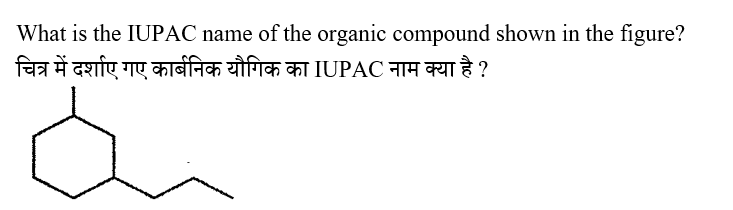
Question 6: Bihar Ssc (30 June 2024) 1

  • 1-मेथिल-2-प्रोपिलसाइक्लोहेक्सेन 1-Methyl-2-propylcyclohexane

  • 1 - मेथिल - 3 - प्रोपिलसाइक्लोहेक्सेन 1-Methyl-3-propylcyclohexane

  • 1 - मेथिल - 4 - प्रोपिलसाइक्लोहेक्सेन 1-Methyl-4-propylcyclohexane

  • 1 - मेथिल - 1- प्रोपिलसाइक्लोहेक्सेन 1-Methyl-1-propylcyclohexane

Question 7:

Which of the following elements is a member of the actinide series?

निम्नलिखित में से कौन-सा तत्व एक्टिनाइड श्रेणी का सदस्य है? 

  • थोरियम (Thorium) 

  • लैंथेनम (Lanthanum) 

  • ल्यूटीशियम (Lutetium) 

  • मैग्नीशियम (Magnesium)

Question 8:

Who described in 1662 that when a gas is pumped into a closed vessel, it will compress to settle in the vessel, but the pressure exerted by the gas on the vessel will increase?

1662 में किसने वर्णित किया कि जब किसी गैस को एक बंद पात्र में पंप किया जाता है, तो वह उस पात्र में व्यवस्थित होने के लिए संकुचित हो जाएगी, परंतु पात्र पर गैस द्वारा डाला गया दाब बढ़ जाएगा? 

  • एमेडियो आवोगाद्रो Amedeo Avogadro

  • जैक्स चार्ल्स Jacques Charles

  • जोसेफ गे लुसाक Joseph Gay Lussac

  • रॉबर्ट बॉयल Robert Boyle

Question 9:

Which of the following elements has variable valency?

निम्नलिखित में से किस तत्त्व की परिवर्ती संयोजकता होती है? 

  • सल्फर Sulphur

  • मैगनीशियम Magnesium

  • सोडियम Sodium

  • आयरन Iron

Question 10:

Which of the following statements about mixtures is not correct?

मिश्रण के संदर्भ में निम्नलिखित में से कौन-सा कथन सही नहीं है? 

  • कोलाइड एक विषमांगी मिश्रण है, जिसके कणों का आकार बड़ा होता है। Colloid is a heterogeneous mixture whose particles are large in size.

  • विलयन दो या दो से अधिक पदार्थों का समांगी मिश्रण है। A solution is a homogeneous mixture of two or more substances.

  • विलयन के छोटे अवयव को विलेय कहते हैं। The smaller component of a solution is called the solute.

  • विलयन के बड़े अवयव को विलायक कहते हैं। The larger component of a solution is called the solvent.

Scroll to Top
SSC Selection Post Phase 14 Exam Date Out, But When Is SSC CGL Exam? UPSI Recruitment: Court’s Big Decision on Waiting List SSC Exam Pattern Changed? Know the Latest Updates SSC GD Agniveer Reservation: SSC Gives Major Update What Are Brainstorming and Flipped Classrooms? Easy Explanation