Union Public Service Commission (UPSC) ने Indian Forest Service (IFoS) Mains Exam Date 2026 की घोषणा कर दी है। जो भी Candidates इस साल अपना Civil Services (Preliminary) Exam पास कर चुके हैं उन्हें अब Mains एग्जाम देना होगा। यह Mains Exam अब 22 November 2026 (Sunday) से शुरू होकर 29 November 2026 (Sunday) तक चलेगा। यह भारत सरकार की एक बहुत ही बड़ी नौकरी है। एक IF0S Officer का काम देश के जंगलों, पर्यावरण, और Wildlife को बचाना और उन्हें बढ़ाना होता है।
UPSC IFoS Mains Exam Date 2026 Out : Overview
UPSC IFoS Mains Exam 2026 की तैयारी शुरू करने से पहले उससे जुड़ी हुई कुछ ज़रूरी जानकारियों को समझना Important है। नीचे दी गई Table में Organisation Name, Vacancy, Salary, और Official Website जैसी जानकारियों का Overview दिया गया है।
| Organisation Name | Union Public Service Commission (UPSC) |
| Advertisement Number | 06/2026-IFoSE |
| Post | Indian Forest Service (IFS) |
| Vacancy | 80 Vacancies |
| Exam Date | 22-11-2026 To 29-11-2026 |
| Salary | Level 10 As Per Government Rules (7th Pay Commission) |
| Selection Process |
|
| Website Link | https://upsc.gov.in |
Also Read : UPSC ESE Notification 2027 Out
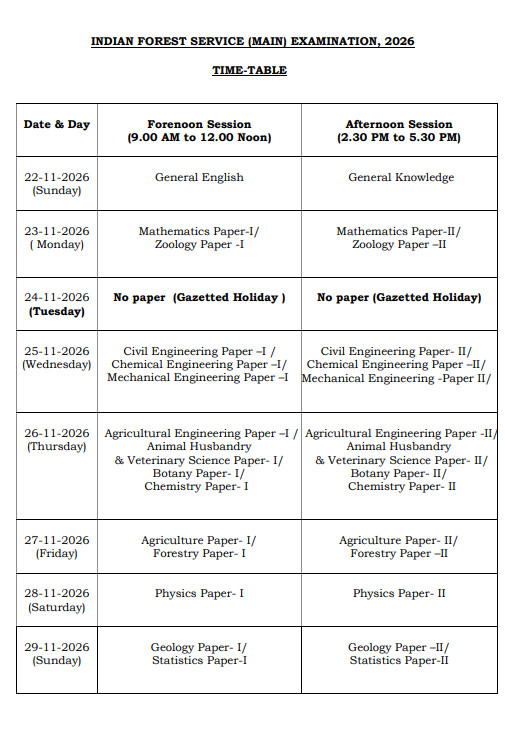
Mains Examination Time Table
| Date & Day | Forenoon Session (9:00 AM to 12:00 Noon) | Afternoon Session (2:30 PM to 5:30 PM) |
| 22-11-2026 (Sunday) | General English | General Knowledge |
| 23-11-2026 (Monday) | Mathematics Paper-I / Zoology Paper-I | Mathematics Paper-II / Zoology Paper-II |
| 24-11-2026 (Tuesday) | No Paper (Gazetted Holiday) | No Paper (Gazetted Holiday) |
| 25-11-2026 (Wednesday) | Civil Engineering Paper-I / Chemical Engineering Paper-I / Mechanical Engineering Paper-I | Civil Engineering Paper-II / Chemical Engineering Paper-II / Mechanical Engineering Paper-II |
| 26-11-2026 (Thursday) | Agricultural Engineering Paper-I / Animal Husbandry & Veterinary Science Paper-I / Botany Paper-I / Chemistry Paper-I | Agricultural Engineering Paper-II / Animal Husbandry & Veterinary Science Paper-II / Botany Paper-II / Chemistry Paper-II |
| 27-11-2026 (Friday) | Agriculture Paper-I / Forestry Paper-I | Agriculture Paper-II / Forestry Paper-II |
| 28-11-2026 (Saturday) | Physics Paper-I | Physics Paper-II |
| 29-11-2026 (Sunday) | Geology Paper-I / Statistics Paper-I | Geology Paper-II / Statistics Paper-II |
UPSC IFoS Mains Exam Date 2026 Out : Exam Pattern
जिस Mains Exam की Date आई है, उस Exam का Pattern जानना हर Candidate के लिए ज़रूरी है। नीचे दी गई Table में आपको पता चलेगा कि Mains में कुल कितने Papers होते हैं, उनके Total Marks क्या हैं और हर Paper के लिए कितना Time मिलता है।
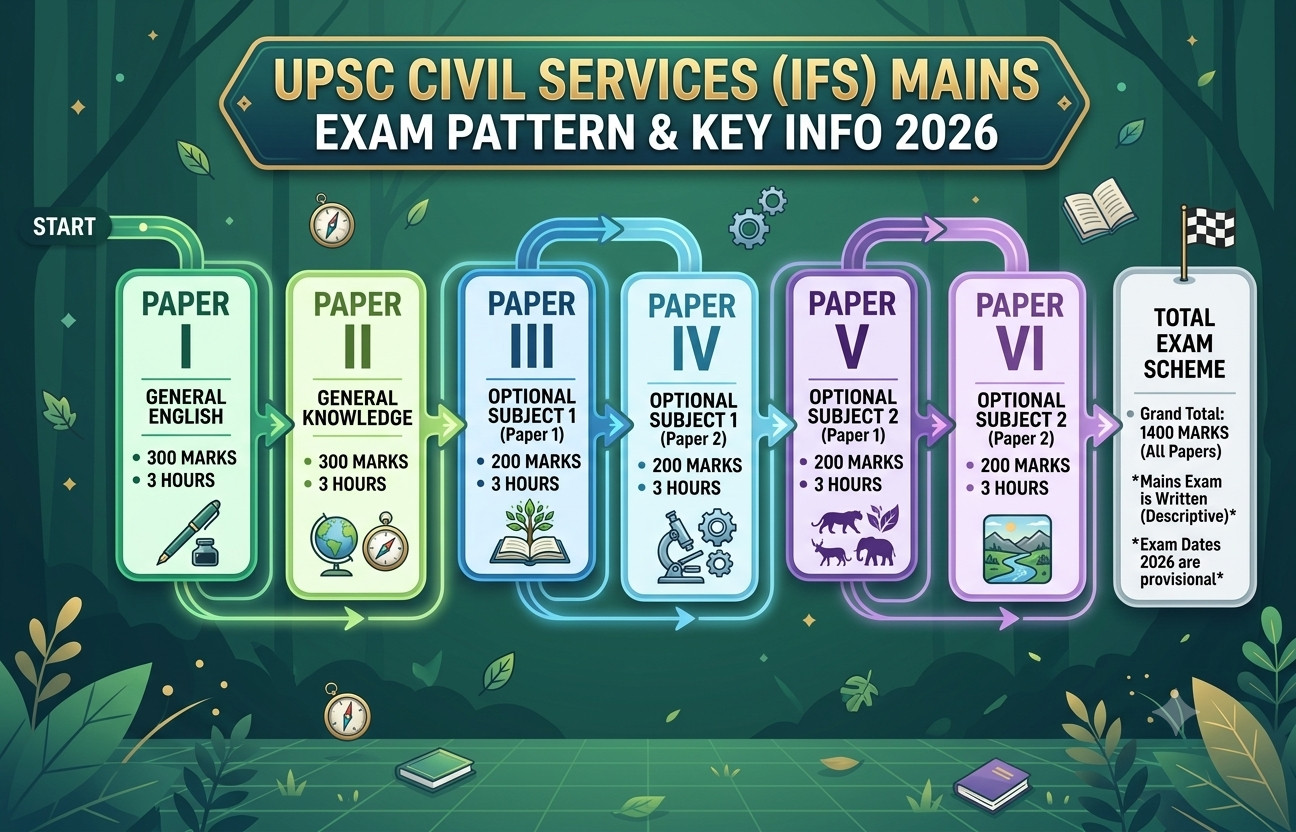
| Paper Name | Subject | Total Marks | Time Duration |
| Paper I | General English | 300 Marks | 3 Hours |
| Paper II | General Knowledge | 300 Marks | 3 Hours |
| Paper III | Optional Subject 1 (Paper 1) | 200 Marks | 3 Hours |
| Paper IV | Optional Subject 1 (Paper 2) | 200 Marks | 3 Hours |
| Paper V | Optional Subject 2 (Paper 1) | 200 Marks | 3 Hours |
| Paper VI | Optional Subject 2 (Paper 2) | 200 Marks | 3 Hours |
Also Read : UPPSC PCS Mains Result 2025
UPSC IFoS Mains Exam Date 2026 Out : Syllabus
नीचे दी गई Table में हमने General English, General Knowledge और Optional Subjects का Syllabus बहुत ही Detail में समझाया है।
| Paper | Syllabus |
| General English |
|
| General Knowledge |
|
| Optional Subjects |
|
Subject-Wise Break Down
| Subject | Topics |
| Agriculture | Paper I: • Ecology • Cropping patterns and related topics • Forestry plantations • Soil • Farm management • Agricultural extension, etc. Paper II: • Cell Theory • Cytoplasmic inheritance • Seed technology • Physiology • Growth and development • Pests and diseases • Food production |
| Animal Husbandry & Veterinary Science | Paper I: • Animal Nutrition • Animal Physiology • Livestock Production and Management • Genetics and Animal Breeding Paper II: • Health and Hygiene • Veterinary Public Health • Animal Diseases • Milk and Milk Products Technology • Meat Hygiene and Technology • Extension |
| Chemistry | Paper I: • Atomic structure • Chemical bonding • Solid State • The gaseous state • Thermodynamics and statistical thermodynamics • Phase equilibria and solutions • Electrochemistry • Chemical kinetics • Photochemistry • Surface phenomena and catalysis • Bio-inorganic chemistry • Coordination chemistry • General chemistry of ‘f’ block elements • Non-Aqueous Solvents Paper II: • Delocalised covalent bonding • Pericyclic reactions • Reactions • Chemistry and mechanism of reactions • Polymeric Systems • Synthetic uses of reagents • Photochemistry • Principles of spectroscopy and applications in structure elucidation |
| Agricultural Engineering | Paper I: • Soil and Water Conservation • Aerial Photography and Remote Sensing • Irrigation and Drainage • Agricultural Structures Paper II: • Farm Power and Machinery • Agro-energy • Agricultural Process Engineering • Instrumentation and Computer Applications in Agricultural Engineering |
| Botany | Paper I: • Microbiology and Plant Pathology • Cryptogams • Phanerogams • Plant Utility and Exploitation • Morphogenesis Paper II: • Cell Biology • Genetics, Molecular Biology and Evolution • Plant Breeding, Biotechnology and Biostatistics • Physiology and Biochemistry • Ecology and Plant Geography |
| Civil Engineering | Paper I: • Strength of materials • Structural analysis • Engineering Mechanics • Structural Steel Design • Design of Concrete and Masonry Structures • Fluid Mechanics, Open channel flow, and Hydraulic Mechanics • Hydraulic Machine and Hydropower • Geotechnical engineering Paper II: • Construction Technology • Construction Equipment • Survey and Transport Engineering • Hydrology, Water Resources, and Engineering • Environmental Engineering |
| Chemical Engineering | Paper I: • Fluid and Particle Dynamics • Mass Transfer • Heat Transfer • Novel Separation Processes • Process Equipment Design • Process Dynamics and Control Paper II: • Material and Energy Balances • Chemical Engineering Thermodynamics • Chemical Reaction Engineering • Chemical Technology • Environmental Engineering and Safety • Process Engineering Economics |
| Forestry | Paper I: • Silviculture • Agroforestry, Social Forestry, Joint Forest Management and Tribology • Forest Soils, Soil Conservation and Watershed management • Environmental Conservation and Biodiversity • Tree Improvement and Seed Technology Paper II: • Forest Management and Management Systems • Forest Working Plan • Forest Mensuration and Remote Sensing • Surveying and Forest Engineering • Forest Resources and Utilization • Forest Ecology and Ethnobotany • Forest Protection & Wildlife Biology • Forest Economics and Legislation |
| Mathematics | Paper I: • Linear Algebra • Calculus • Analytic Geometry • Dynamics, Statics, and Hydrostatics • Vector Analysis • Ordinary Differential Equations Paper II: • Algebra • Real Analysis • Complex Analysis • Linear Programming • Partial differential equations • Numerical Analysis and Computer programming • Numerical integration • Numerical solution of ordinary differential equations • Computer Programming • Mechanics and Fluid Dynamics |
| Mechanical Engineering | Paper I: • Theory of Machines • Mechanics of Solids • Engineering Materials • Manufacturing Science • Manufacturing Management • Elements of Computation Paper II: • Thermodynamics • I.C. Engines, Fuels and Combustion • Heat Transfer, Refrigeration and Air Conditioning • Turbomachine and Powerplants |
| Physics | Paper I: • Classical Mechanics • Special Relativity, Waves & Geometrical Optics • Physical Optics • Electricity and Magnetism • Electromagnetic Theory & Black Body Radiation • Thermal and Statistical Physics Paper II: • Quantum Mechanics I • Quantum Mechanics II & Atomic Physics • Molecular Physics • Nuclear Physics • Particle Physics & Solid State Physics • Electronics |
| Zoology | Paper I: • Non-Chordata and Chordata • Ecology • Ethology • Economic Zoology • Biostatistics • Instrumental Methods Paper II: • Cell Biology • Genetics • Evolution • Systematics • Biochemistry • Physiology • Developmental Biology |
| Statistics | Paper I: • Probability • Statistical Inference • Linear Inference and Multivariate Analysis • Sampling Theory and Design of Experiments Paper II: • Industrial Statistics • Optimization Techniques • Quantitative Economics and Official Statistics • Demography and Psychometry |
| Geology | Paper I: • General Geology • Geomorphology and Remote Sensing • Structural Geology • Paleontology • Stratigraphy and Geology of India • Hydrogeology and Engineering Geology Paper II: • Mineralogy • Igneous and Metamorphic Petrology • Sedimentology • Economic Geology • Mining Geology • Geochemistry and Environmental Geology |
What’s After The Exam?
- Detailed Application Form (DAF): जो Candidates Written Exam पास करते हैं, उन्हें Interview से पहले एक Detailed Application Form (DAF) भरना पड़ता है। इसमें Educational Qualification के Proof, Achievements, Service Experience, और Cadre Preference जैसी Details भरनी होती हैं।
- Interview: Mains Exam (Written) में पास होने वाले Candidates को अंत में Interview के लिए बुलाया जाता है। यह Interview पूरे 300 Marks का होता है और इसमें कोई Minimum Qualifying Marks नहीं होते हैं। Interview Board आपकी Mental Qualities, Intellectual Curiosity, Critical Powers Of Observation, Balance Of Judgment, Initiative, Tact, Leadership Capacity, Social Cohesion, Integrity Of Character, Topographical Sense, और Outdoor Life के लिए प्यार को देखता है।
- Document Verification: Interview के समय, Candidates की Eligibility Conditions (जैसे Date Of Birth, Educational Qualification, Category, PwBD Status) की Original Documents के साथ जाँच की जाती है।
- Medical Standard Test: IFS एक Field Job है, इसलिए Candidates को Physically Fit होना चाहिए। Government द्वारा बनाए गए Physical Standards और Medical Rules (जैसे Walking Test और Medical Examination) के आधार पर आपका Checkup होता है।
- Final Merit List: आपके Mains Exam (Written) और Interview (Personality Test) के Total Marks को जोड़कर Final Ranking बनाई जाती है। Preliminary Exam के Marks Final Merit List में नहीं जोड़े जाते हैं। अगर दो Candidates के Total Marks बराबर होते हैं, तो Tie Breaking Principle का इस्तेमाल किया जाता है।
- Cadre Allocation: Select होने वाले सफल Candidates को उनकी Rank और Preference के हिसाब से State Cadre Allot किया जाता है।
Related Links :
| RWA Civil Services Batches | RWA IAS YouTube Channel |
Last Minute Preparation Tips
- Revise Your Notes: अब परीक्षा में बहुत कम समय बचा है, इसलिए अब नया कुछ भी पढ़ने का समय नहीं है। आपने साल भर में जो भी Short Notes बनाए हैं, बस उन्हें बार-बार Revise करें।
- Practice Answer Writing: Mains Exam पूरी तरह से Subjective होता है, इसलिए इसमें आपकी लिखने की Speed बहुत मायने रखती है। रोज़ घर पर कम से कम दो Answers लिखने की Practice ज़रूर करें।
- Time Management: Exam Hall के अंदर 3 Hours में लम्बा Paper पूरा करना एक बहुत बड़ा Challenge होता है। घर पर पुराने Papers और Mock Tests देकर अपना Time Manage करना अच्छे से सीखें।
- Focus On General English: बहुत से Students English को हल्के में लेते हैं, लेकिन यह 300 Marks का बहुत ही Scoring Paper होता है। Essay और Precis Writing की रोज़ Practice करें।
- Stay Healthy And Sleep Well: परीक्षा के दिनों में अच्छी नींद लें और Healthy खाना खाएं।
Note: हमेशा अपने e-Admit Card और Photo ID Card को Exam Date से दो दिन पहले ही Print करके रख लें।
Frequently Asked Questions
| Q1. What Items Are Strictly Prohibited Inside The IFS Mains Examination Hall? |
| Ans. Mobile Phones, Bluetooth Devices, Pagers, Programmable Devices, Pen Drives, Smart Watches, Cameras, Books, Notes, Loose Sheets, And Log Tables Are Strictly Prohibited Inside The Examination Hall. |
| Q2. Will My Candidature Be Rejected If I Am Found With A Switched-Off Mobile Phone During The Exam? |
| Ans. Yes, Being In Possession Of A Mobile Phone, Even In Switched-Off Mode, Is Strictly Prohibited And Will Lead To Disciplinary Action Including A Ban From Future Examinations. |
| Q3. Can I Write Some Of My Answers Using A Blue Pen In The Mains Exam? |
| Ans. No, The Notification Strictly Instructs Candidates To Use A Black Ball Pen For Both Writing And Marking Answers In The Examination. |
| Q4. What Will Happen If I Put An Unrelated Mark Or Sign In My Answer Script To Help The Examiner Identify Me? |
| Ans. If Any Irrelevant Matter Or Signage Is Found Which Has The Potential To Disclose The Candidate’s Identity, The Commission Will Deduct Marks Or May Even Not Evaluate That Answer Script. |
| Q5. Is There Any Penalty For Writing An Answer That Shows Only Superficial Knowledge? |
| Ans. According To The Instructions For The Mains Examination, Marks Will Not Be Allotted For Mere Superficial Knowledge. Candidates Are Expected To Give Exact And Orderly Expressions. |