Bsnl

BSNL JTO Exam Date 2026 Out : Know Exam Pattern In Detail Here !!

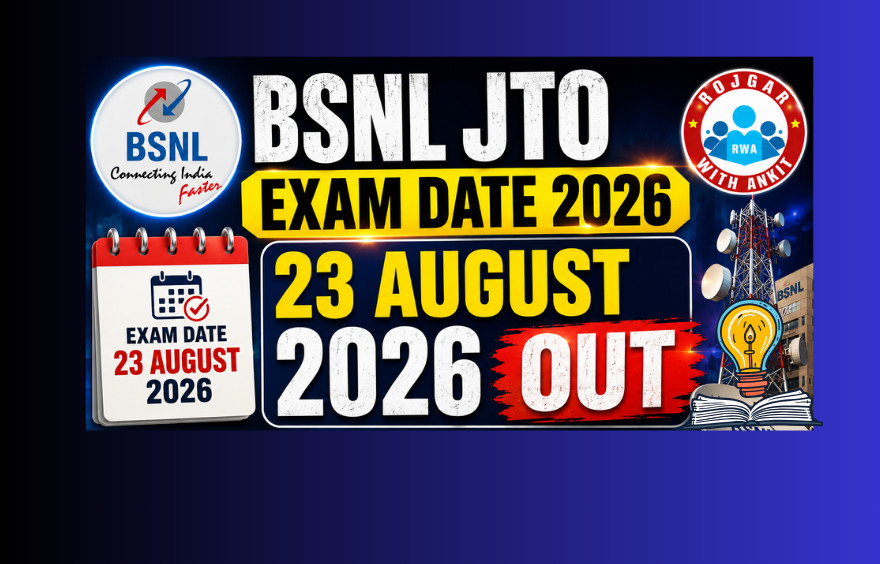
BSNL ने Junior Telecom Officer (JTO) भर्ती 2026 की Exam Date अधिकारिक रूप रूप से जारी कर दी है। इस भर्ती के तहत कुल 100 पदों पर भर्ती की जाएगी। लिखित परीक्षा का आयोजन 23 August 2026 (Sunday) को Computer Based Test (CBT) Mode में होगा| Candidates को सलाह दी जाती है कि वे Official Syllabus के अनुसार Regular Revision करें, Previous Year Papers और Mock Tests की Practice करें तथा Important Topics पर ज्यादा Focus रखें।
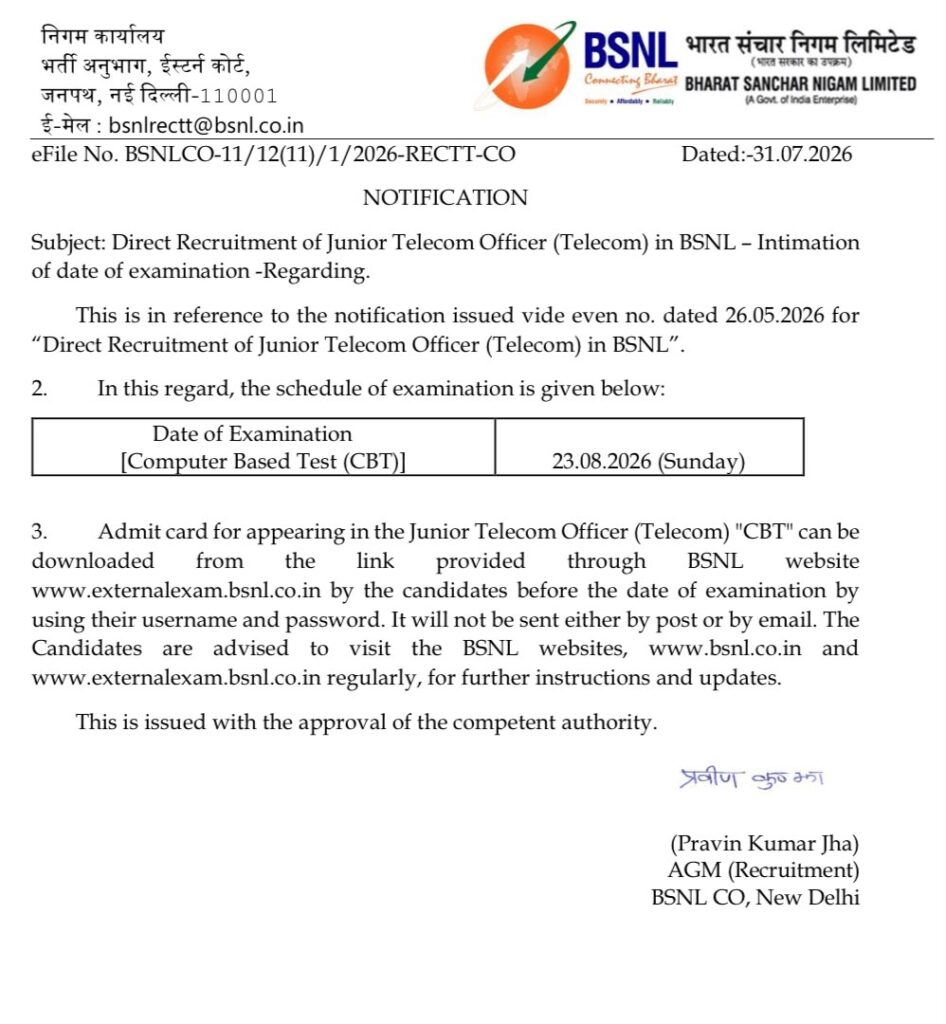
किसी भी Fake News या Unofficial Sources पर भरोसा न करें। परीक्षा से जुड़ी सभी Official Updates के लिए समय-समय पर BSNL की Official Website www.bsnl.co.in चेक करते रहें।

BSNL JTO Exam Date 2026 Out : Overview 

नीचे दी गई Table में इस पूरी भर्ती का एक Brief Overview दिया गया है। इस Table की मदद से आप Organization Name, Post Name, Total Vacancies, Age Limit, Application Fee, Selection Process और Official Website जैसी सभी महत्वपूर्ण जानकारी एक ही जगह पर आसानी से देख सकते हैं।
Details Information
Organization Name Bharat Sanchar Nigam Limited (BSNL)
Post Name Junior Telecom Officer- Telecom (JT0- T)
Advertisement / CEN No. BSNLCO-11/12(11)/1/2026-RECTT-CO
Total Vacancies 100 Posts (Direct Recruitment)
Exam Date 23 August 2026 (Sunday)
Age Criteria
  • Minimum Age: 20 Years
  • Maximum Age: 30 Years
Selection Process
  • Online CBT Exam
  • Document Verification
  • Medical Exam
Salary IDA Pay Scale [E-1] of ₹ 16,400- ₹ 40,500/- (2nd PRC Pay Scale)
Official Website www.bsnl.co.in

BSNL JTO Exam Date 2026 Out : Exam Pattern

BSNL Junior Telecom Officer (JTO) Exam 2026 का Written Exam Computer Based Test (CBT) Mode में आयोजित किया जाएगा। परीक्षा में Engineering Subjects के साथ General Ability से भी Questions पूछे जाएंगे। नीचे दिए गए टेबल में BSNL JTO Exam Pattern 2026 की पूरी जानकारी दी गई है:
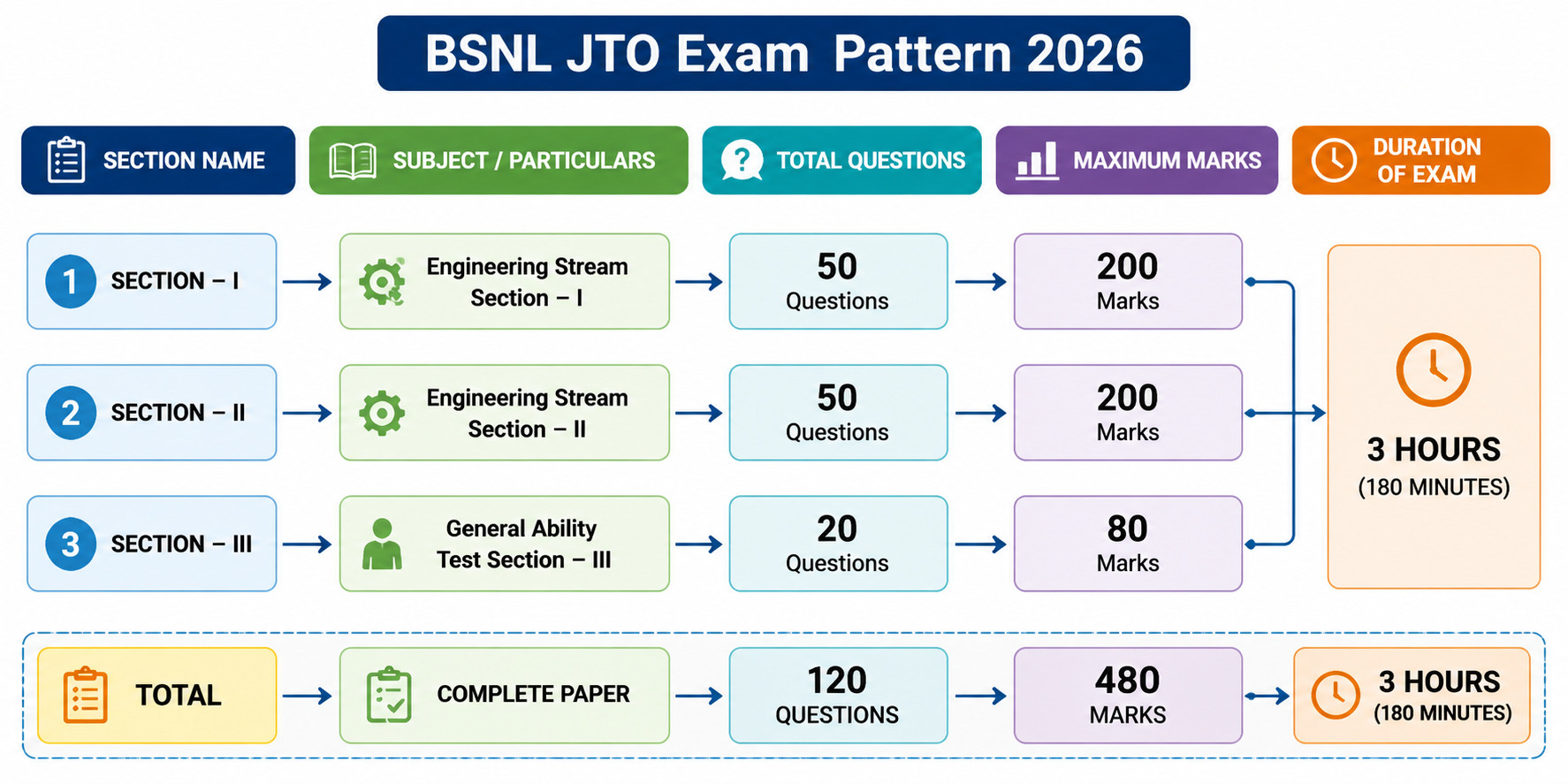
Section Name Subject / Particulars Total Questions Maximum Marks Duration of Exam
Section- I Engineering Stream Section- I 50 Questions 200 Marks  

3 Hours

Section- II Engineering Stream Section- II 50 Questions 200 Marks
Section- III General Ability Test Section- III 20 Questions 80 Marks
Total Complete Paper 120 Questions 480 Marks

Important Details:

Particulars Details
Exam Mode Computer Based Test (CBT)
Question Type Multiple Choice Questions (MCQ)
Marks for Each Correct Answer +4 Marks
Negative Marking -1 Mark for each incorrect answer
Minimum Qualifying Marks (UR & OBC-CL)
  • UR & OBC-CL: Minimum 40% in Each Section and 50% Overall
  • SC/ST, OBC-NCL, EWS & PwBD: Minimum 35% in Each Section and 45% Overall

BSNL JTO Exam Date 2026 Out : Syllabus 

BSNL Junior Telecom Officer JTO परीक्षा का Syllabus नीचे टेबल में दिया गया है। Candidates Subject-wise Topics को देखकर अपनी तैयारी बेहतर तरीके से कर सकते हैं:

Section Topic Syllabus
SECTION-I (Engineering Stream) Materials and Components
  • Structure and properties of Electronic Engineering materials
  • Conductors
  • Semiconductors and Insulators
  • Magnetic, Ferroelectric
  • Piezoelectric
  • Ceramic
  • Optical and Superconducting materials
  • Passive components and Characteristics
  • Resistors, Capacitors and Inductors
  • Ferrites
  • Quartz Crystal
  • Ceramic Resonators
  • Electromagnetic and Electromechanical Components
Physical Electronics, Electron Devices and ICs
  • Electrons and Holes in Semiconductors
  • Carrier Statistics
  • Mechanics of Current Flow in a Semiconductor
  • Hall Effect
  • Junction Theory
  • Different Types of Diodes and their Characteristics
  • Bipolar Junction Transistor (BJT)
  • Field Effect Transistors (FET)
  • Power Switching Devices like SCRs, CTOs, Power MOSFETs, Basics of ICs (Bipolar, MOS and CMOS Types)
  • Basics of Opto Electronics.
Network Theory
  • Network Analysis Techniques
  • Network Theorem
  • Transient and Steady-State Sinusoidal Response
  • Transmission Criteria (Delay and Rise Time)
  • Elmore’s and other definitions
  • Effect of Cascading, Elements of Network Synthesis.
Electromagnetic Theory Transmission Lines:
  • Basic Theory
  • Standing Waves
  • Matching Applications
  • Microstrip Lines
  • Basics of Waveguides and Resonators
  • Elements of Antenna Theory
Electronic Measurements and Instrumentation
  • Basic Concepts
  • Standards and Error Analysis
  • Measurements of Basic Electrical Quantities and Parameters
  • Electronic Measuring Instruments and their Principles of Working (Analog and Digital)
  • Comparison
  • Characteristics
  • Applications
  • Transducers
  • Electronic Measurements of Non-Electrical Quantities such as Temperature, Pressure, Humidity, Basics of Telemetry for Industrial Use
Power Electronics
  • Power Semiconductor Devices
  • Thyristor
  • Power Transistor
  • MOSFETs
  • Characteristics and Operation
  • AC to DC Convertors
  • 1-Phase and 3-Phase DC to DC Convertors
  • AC Regulators
  • Thyristor Controlled Reactors
  • Switched Capacitor Networks
  • Inverters (Single-Phase and 3-Phase)
  • Pulse Width Modulation
  • Sinusoidal Modulation with Uniform Sampling
  • Switched Mode Power Supplies
SECTION-II (Engineering Stream) Analog Electronic Circuits
  • Transistor Biasing and Stabilization
  • Small Signal Analysis
  • Power Amplifiers
  • Frequency Response
  • Wide Band Techniques
  • Feedback Amplifiers Tuned Amplifiers
  • Oscillators
  • Rectifiers and Power Supplies
  • Operational Amplifiers
  • Other Linear Integrated Circuits and Applications
  • Pulse Shaping Circuits and Waveform Generators.
Digital Electronic Circuits
  • Transistor as a Switching Element
  • Boolean Algebra
  • Simplification of Boolean Functions
  • Karnaugh Map and Applications
  • IC Logic Gates and Characteristics
  • Logic Families (DTL, TTL, ECL, NMOS, PMOS, CMOS)
  • Combinational Logic Circuits
  • Half Adder
  • Full Adder
  • Multiplexer
  • Demultiplexer
  • ROM and Applications
  • Flip-Flops (RS, JK, D, T)
  • Counters
  • Registers
  • Waveform Generators
  • A/D and D/A Convertors
  • Semiconductor Memories
Control Systems
  • Transient and Steady-State Response
  • Effect of Feedback on Stability and Sensitivity
  • Root Locus Techniques
  • Frequency Response Analysis
  • Gain and Phase Margins
  • Constant-M and Constant-N Nichol’s Chart
  • Approximation of Transient Response from Open and Closed Loop Frequency Response
  • Design of Control Systems
  • Compensators, Industrial Controllers
Communication Systems
  • Basic Information Theory
  • Modulation and Detection in Analogue and Digital Systems
  • Sampling and Data Reconstruction
  • Quantization and Coding
  • Time Division and Frequency Division Multiplexing
  • Equalisation
  • Optical Communication (Free Space and Fibre Optic)
  • Propagation of Signals at HF, VHF, UHF and Microwave Frequencies
  • Satellite Communication
Microwave Engineering
  • Microwave Tubes and Solid-State Devices
  • Microwave Generation and Amplifiers
  • Waveguides and Microwave Components and Circuits
  • Microstrip Circuits, Microwave Antennas
  • Microwave Measurements
  • MASERS
  • LASERS
  • Microwave Propagation
  • Microwave Communication Systems (Terrestrial and Satellite Based)
Computer Engineering
  • Number Systems
  • Data Representation
  • Programming, Elements of High-Level Programming Languages (PASCAL/C)
  • Use of Basic Data Structures
  • Fundamentals of Computer Architecture
  • Processor Design
  • Control Unit Design
  • Memory Organization
  • I/O System Organization
  • Personal Computers and their Typical Uses
Microprocessors
  • Microprocessor Architecture
  • Instruction Set
  • Simple Assembly Language Programming
  • Interfacing for Memory and I/O
  • Applications of Microprocessors in Telecommunications and Power Systems
SECTION-III (General Ability Test) General Ability
  • General English Comprehension and Understanding
  • Current Affairs
  • Everyday Observation and Scientific Awareness
  • Developments in Telecommunications
  • History of India
  • Geography
  • Questions will be of a nature that can be answered without special study by an educated person.

What’s Next After the CBT Exam?

  • Computer Based Test (CBT): सबसे पहले Candidates को CBT (MCQ) Exam देना होगा।
  • Merit List: CBT में मिले Marks के आधार पर Merit List तैयार की जाएगी।
  • Document Verification (DV): Merit List में शामिल Candidates को Original Documents Verification के लिए बुलाया जाएगा।
  • Medical Examination: DV पास करने वाले Candidates का Medical Test होगा।
  • Training: Medical Fit Candidates को 20 Weeks Training पूरी करनी होगी, जिसमें 10 Weeks Phase-I Training, 4 Weeks Field Training और 6 Weeks Phase-II Training शामिल होगी।
  • Final Appointment: सभी Stages सफलतापूर्वक पूरा करने के बाद Candidates को Junior Telecom Officer (JTO) Post पर Appointment दी जाएगी|

Preparation Tips

  • Understand the Syllabus: सबसे पहले ऊपर दिए गए Syllabus का Print निकाल लें और देखें कि आपको कौन-कौन से Topics पढ़ने हैं।
  • Clear Basic Concepts: Engineering के विषय काफी Technical होते हैं। इसलिए अपने Degree के Basics को फिर से Revise करें। खास तौर पर Communication और Network Theory पर ज्यादा ध्यान दें।
  • Make Short Notes: पढ़ते समय हर Topic के Short Notes जरूर बनाएं। Exam से पहले Revision करने में ये Notes बहुत काम आते हैं।
  • Previous Year Papers: BSNL के पुराने Question Papers को Solve करें। इससे आपको अंदाज़ा लग जाएगा कि Exam में किस Level के Questions पूछे जाते हैं।
  • Mock Tests: Online Mock Test देना शुरू करें। इससे आपकी Speed बढ़ेगी और आपको Time Management करना आ जाएगा। याद रखें Exam में 3 घंटे में 120 Questions करने हैं।
  • Avoid Negative Marking: Exam में Negative Marking (-1 Mark) है। इसलिए जिस Question का Answer आपको बिल्कुल नहीं पता, उसे छोड़ देना ही बेहतर है।

Some Important Link :

Leave a Comment

Your email address will not be published. Required fields are marked *

Index
Exit mobile version